Concert Program
Friday 18 Jul 2025 7:30pm
Federation Concert Hall, Nipaluna / Hobart
Looking for tickets? Go here.

The Tasmanian Symphony Orchestra acknowledges the traditional owners and continuing custodians of Lutruwita / Tasmania. We pay respect to the Aboriginal community today, and to its Elders past and present. We recognise a history of truth, which acknowledges the impacts of colonisation upon Aboriginal and Torres Strait Islander people and stand for a future that profoundly respects their stories, culture, language and history.
Falla The Three-Cornered Hat, Suite No 1 (12 mins)
5 movements
Rachmaninov Rhapsody on a Theme of Paganini, Op 43 (22 mins)
20 minute interval
Venegas At the Aegean Shores (8 mins)
Stravinsky The Firebird, Suite (1945 version) (29 mins)
💡 FIRST-TIMER TIP
Longer pieces of music are often broken up into bite-size pieces called ‘movements’. It makes it easier to perform and provides contrast within the work. Find out more here.

Sergei Rachmaninoff.
The Three-Cornered Hat, Suite No 1
Composed by Manuel de Falla (1876 – 1946)
12 minutes
Spanish composer Manuel de Falla’s The Three-Cornered Hat began life as a ballet, full of colour, dance, and humour. It was written in 1919 for the famous Ballets Russes company and tells a light-hearted story of love, mischief, and mistaken identity in a small Spanish village.
The music is bursting with the rhythms and spirit of Spanish folk dance. It’s lively, bright, and full of character. Suite No 1 brings together several highlights from the first part of the ballet.
The suite opens with the Introduction, a dramatic and bold piece that immediately sets the stage with strong rhythms and striking harmonies. Next comes the Afternoon, which paints a picture of a sunny village scene. The music is gentler here, with playful touches that hint at the humour and charm of the ballet’s characters.
The last movement in the suite is the Dance of the Miller’s Wife. This is one of the most famous parts of the ballet, full of energy and attitude. The music has sharp rhythms, fast footwork, and a real sense of Spanish flair. You can almost see the dancer’s fan snapping shut and her eyes flashing as she teases and twirls across the stage.
Falla worked closely with Spanish dancers and drew heavily on traditional Spanish music and rhythms. But he also used the full power of the orchestra to bring these scenes to life, blending folk style with classical technique in a fresh and exciting way.
Suite No1 from The Three-Cornered Hat gives a wonderful taste of this vibrant ballet – bold, joyful, and unmistakably Spanish. It’s a perfect example of how music can tell a story without a single word.
Rhapsody on a Theme of Paganini, Op 43
Composed by Sergei Rachmaninov (1873 – 1943)
22 minutes
Rachmaninov’s Rhapsody on a Theme of Paganini is one of his most popular works. It’s a dazzling showpiece for piano and orchestra that is full of drama, wit, and beauty. Written in 1934, it was one of his last major compositions and shows his genius for melody, colour and variation.
The piece is based on a short but famous tune by the 19th-century violinist Niccolò Paganini – his Caprice No 24. This theme has inspired many composers, but Rachmaninov’s version is among the most creative. He doesn’t just decorate the tune; he completely transforms it across 24 variations, each one bringing a new mood, style, or surprise.
Some variations are fiery and fast, showing off the pianist’s speed and power. Others are lyrical and tender. One of the most surprising moments comes in Variation 18, where Rachmaninov flips the theme upside down and turns it into a soaring, romantic melody – one of the most loved tunes in all of classical music.
Throughout the piece, you’ll also hear a dark, chant-like melody known as the Dies Irae, an ancient tune from the Latin Mass for the Dead. Rachmaninov often used this melody in his music, and here it adds a hint of mystery and drama.
Although it plays as one continuous piece, the Rhapsody feels almost like a mini piano concerto, with fast, slow, and fast sections. The piano and orchestra interact closely, sometimes in playful competition, sometimes in perfect harmony.
With its mix of bold ideas, emotional depth, and jaw-dropping virtuosity, Rhapsody on a Theme of Paganini shows just how much you can say through music – from playful sparks to heartfelt moments.
At the Aegean Shores
Composed by Saskia Venegas Aernouts (b.1983)
8 minutes
Saskia Venegas Aernouts is a Spanish-Belgian composer, music theater maker, and violinist, now based in the Netherlands. At the Aegean Shores was written in 2017 and premiered by the Antwerp Symphony Orchestra. The work was revised and extended in 2022 for a performance Basque National Orchestra. Tonight’s performance is the premiere of a version of the work prepared especially for the Tasmanian Symphony Orchestra.
From the composer:
At the Aegean Shores is a programmatic piece that reflects on what I witnessed working as a volunteer at a refugee camp in Lesbos during the summer of 2016.
The piece starts by depicting a rubber boat that fights its way through the wild current that separates Turkey from Lesbos. This energetic and textural passage ends in an abrupt clash that depicts the brusque arrival of a dangerously overloaded rubber boat to “the land of hope.” The previously agitated passage is replaced by a contemplative drone that will slowly be coloured with a melody inspired by the rich melodic gestures and modal flavours of Greek music. This melody will be accompanied by rhythmical patterns that represent the prayers of the Orthodox Church (played by the cor anglais) that are imposed on the inhabitants of the island through big speakers placed outside the church walls. The textural metallic fragments played by the string section represent the wind passing through the leaves of the trees of the island, combined with the sound of the many insects that inhabit it. The continuous airy D and A drones performed by the brass are a mixture of the variety of airy sounds that can be perceived on the island, melted with the drones that are used to support soloistic sections of traditional Greek music.
The expressive melodic passage will attempt to develop itself but will gradually be swallowed by a new current (initiated by the strings) that will depict the European bureaucratic system. A system that will strip the newly arrived of their autonomy to decide the direction of their own lives, a system that will fence their movement and freeze their daily routines into an endless wait for approval – an agonizing non-existence. A system that drains the little spark left in their eyes.
And while time passes, these stories become “old news,” whereas boats continue to arrive and people continue to be stuck in huge, inhumane camps. I hope we will be able to find a decent way to include and assist all those who escape from horror. I hope that in the future we will not have to look back at this moment in history and say, “We should have ...”
The Firebird, Suite (1945 version)
Composed by Igor Stravinsky (1882 – 1971)
29 minutes
The Firebird is one of Stravinsky’s most famous and beloved works. Based on a Russian fairy tale, it was originally written as a full ballet in 1910 and later reworked into several shorter concert versions. The 1945 suite is the final version Stravinsky created, carefully refined and arranged for concert performance.
The story follows Prince Ivan, who enters a magical garden and encounters the glowing Firebird – a mystical creature with shimmering feathers. He captures her, but she begs to be set free. Ivan agrees, and in return, she promises to help him if he is ever in danger.
Soon after, Ivan meets thirteen enchanted princesses (yes, thirteen) and falls in love with one of them. But their world is ruled by the evil sorcerer Kashchei, who turns people into stone. When Ivan is captured, the Firebird appears and uses her powers to break Kashchei’s spell. In the end, good triumphs, and the prince and princess are free to live happily.
Stravinsky’s music brings this story to life with vibrant colours, dramatic contrasts, and magical textures. The suite includes some of the most striking moments from the ballet: the mysterious opening, the sparkling Dance of the Firebird, the eerie and frantic Infernal Dance of Kashchei, and the warm, uplifting Finale.
The 1945 version is slightly more compact than the original ballet and is scored for a smaller orchestra, making it ideal for concert settings. Even without dancers, the music tells the story with vivid clarity.
With its mix of mystery, excitement, and wonder, The Firebird launched Stravinsky’s international career and helped shape the sound of 20th-century music. Over a century later, it still captivates audiences with its brilliance and sense of fantasy.
Rewatch all your favourite moments on TSO On Demand.
Streaming sixteen concerts from Federation Concert Hall, this is the full orchestra at its brilliant best.
Conductor

Pablo González brings passion, insight and a theatrical sensibility to communicating music to both orchestras and audiences, most recently as Principal Conductor of Spanish Radio and Television Symphony Orchestra (RTVE), where he also served as Artistic Adviser, between 2019 and 2023.
González enjoys a diverse repertoire, from which he draws compelling programmes. At RTVE he devised themes such as Music under Suspicion, focused on Soviet composers under Stalin’s rule, Echoes of the Belle Époque, culminating in a semi-staged performance of Carmen, and Roots, exploring the influence of folk elements of 19th and 20th-century orchestral repertoire. While drawn instinctively to the passion and power of Russian repertoire, at RTVE he also presented surveys of Berlioz, Mahler and Szymanowski, music by Spanish contemporary composers, and full Beethoven, Schumann and Brahms cycles.
As Music Director of Orquestra Simfònica de Barcelona i Nacional de Catalunya (OBC) from 2010 to 2015, he conducted full Mahler and Schumann cycles; led a central European tour, including an acclaimed appearance at Vienna’s Konzerthaus; recorded and released three volumes of orchestral works by Granados, and Bizet’s Carmen and L’Arlesienne suites (Naxos); and championed many new pieces by Catalan and Spanish composers. He strengthened the orchestra’s community focus, developing a collaborative social project Et toca a tu, bringing the musicians of the OBC together with children who were at risk of social exclusion.
Trained as an actor, he brings a dramatic understanding of music and stagecraft to opera and choral music, and while in Barcelona, conducted productions at Teatre Liceu including Strauss’s Daphne, Wagner’s Rienzi, Mozart’s Die Zauberflöte and Puccini’s Il tabarro, as well as all of Mahler’s orchestral lieder. Highlights of recent seasons include the world premiere of Zarqa AlYamama, the first Arabic-language Grand Opera, by Lee Bradshaw; Turandot for Latvian National Opera; and Tosca, Don Giovanni and Madama Butterfly at Opera de Oviedo.
As a guest conductor, González has developed close relationships with orchestras including Helsinki Philharmonic, Residentie Orchestra, Orchestre Philharmonique Royal de Liège, Orchestre National d’Île de France and Bochum Symphony. In recent seasons he has also collaborated with Frankfurt Radio Symphony, Konzerthausorchester Berlin, Dresden Philharmonic, Royal Philharmonic Orchestra and City of Birmingham Symphony Orchestra. Recent and future projects include debuts with London Philharmonic Orchestra, Milan Symphony Orchestra and NDR Hannover. He is highly in demand in his native Spain, enjoying collaborations with the country’s most prestigious orchestras.
Born in Oviedo, González studied at the Guildhall School of Music and Drama in London and won prizes at the prestigious Donatella Flick and Cadaqués International Conducting competitions. He also took formal training to be an actor at the Academy Drama School in London, as well as taking other drama courses, and has appeared as an actor on stage and film. He has previously served as Principal Guest Conductor of the Orchestra of the City of Granada and Assistant Conductor of the London Symphony Orchestra.
Piano

A stunningly virtuosic pianist, Alexander is internationally recognised for his electrifying and poetic performances. His performance of Rachmaninov’s Piano Concerto No.3 at the BBC Proms was described as “revelatory” by The Times and “electrifying” by Limelight. Alexander was Artist-in-Residence at Wigmore Hall for the 23/24 season.
Highlights of the 2024-25 season include concerto debuts with Hamburger Symphoniker, Orchestre Philharmonique Royal de Liege, Australian Chamber Orchestra, Estonian National Symphony, Phil Zuid, Enescu Philharmonic and Taiwan National Symphony, as well as return visits to Rotterdam Philharmonic, Melbourne Symphony and New Zealand Symphony. Recent highlights also include NDR Hannover, Bournemouth Symphony, Sydney Symphony, Detroit Symphony, Dallas Symphony, Chicago Symphony, San Francisco Symphony and São Paulo Symphony. This season also sees a return to the Concertgebouw Master Pianists Series and a solo recital debut at Philharmonie Luxembourg, as well as recitals throughout Australia and the UK.
Alexander collaborates regularly with conductors including Rafael Payer, Thomas Sondergard, Kirill Karabit, Edward Gardner, Sir Donald Runnicles, Juraj Valcuha and Gustavo Gimeno.
Born in Ukraine in 1984 and holding Australian citizenship, Alexander began his piano studies at the age of seven and gave his first concerto performance when he was nine years old. At the age of 13, Alexander moved to Sydney where he lived until 2006. He won First Prize and Gold Medal at the Horowitz International Piano Competition (1999), First Prize at the Hamamatsu International Piano Competition (2000), and Gold Medal at the Arthur Rubinstein International Piano Masters Competition (2005).
As a recitalist Alexander has performed at the Musikverein in Vienna, Tonhalle Zurich, Victoria Hall Geneva, Southbank Centre’s International Piano Series, Wigmore Hall, Concertgebouw Master Pianists Series, Suntory Hall, Tokyo Opera City Hall, Great Hall of Moscow Conservatory, Cologne Philharmonie, Tokyo City Concert Hall, San Francisco, City Recital Hall in Sydney and Melbourne Recital Centre. Gavrylyuk has appeared at many of the world’s foremost festivals, including the Hollywood Bowl, Bravo! Vail Colorado, Mostly Mozart, the Ruhr Festival and the Kissinger Sommer International Music Festival. Alexander is currently Artist in Residence at Chautauqua Institution.
Violin
Emma McGrath Concertmaster
Ji Won Kim Associate Concertmaster
Jennifer Owen Principal Second
Margaret Blades Principal First
Adrian Biemmi
Natalya Bing
Kirsty Bremner
Miranda Carson
Yue-Hong Cha
Tobias Chisnall
Frances Davies
Michael Johnston
Christine Lawson
Elinor Lea
Susanna Low
Xinyu Mannix
Christopher Nicholas
Rohana O'Malley
Hayato Simpson
💡 FIRST-TIMER TIP
Did you know our Concertmaster plays a violin hand-crafted by one of the finest and most important luthiers (a string-instrument maker) of the nineteenth century, Jean-Baptiste Vuillaume (1798–1875).
He crafted 3000+ instruments in his time and we’re very proud to have a violin made in 1845 on loan from two of our generous Tasmanian patrons.
Viola
Caleb Wright Principal
Douglas Coghill
Sandra Ionescu
Sophie Kesoglidis
Anna Larsen Roach
William Newbery
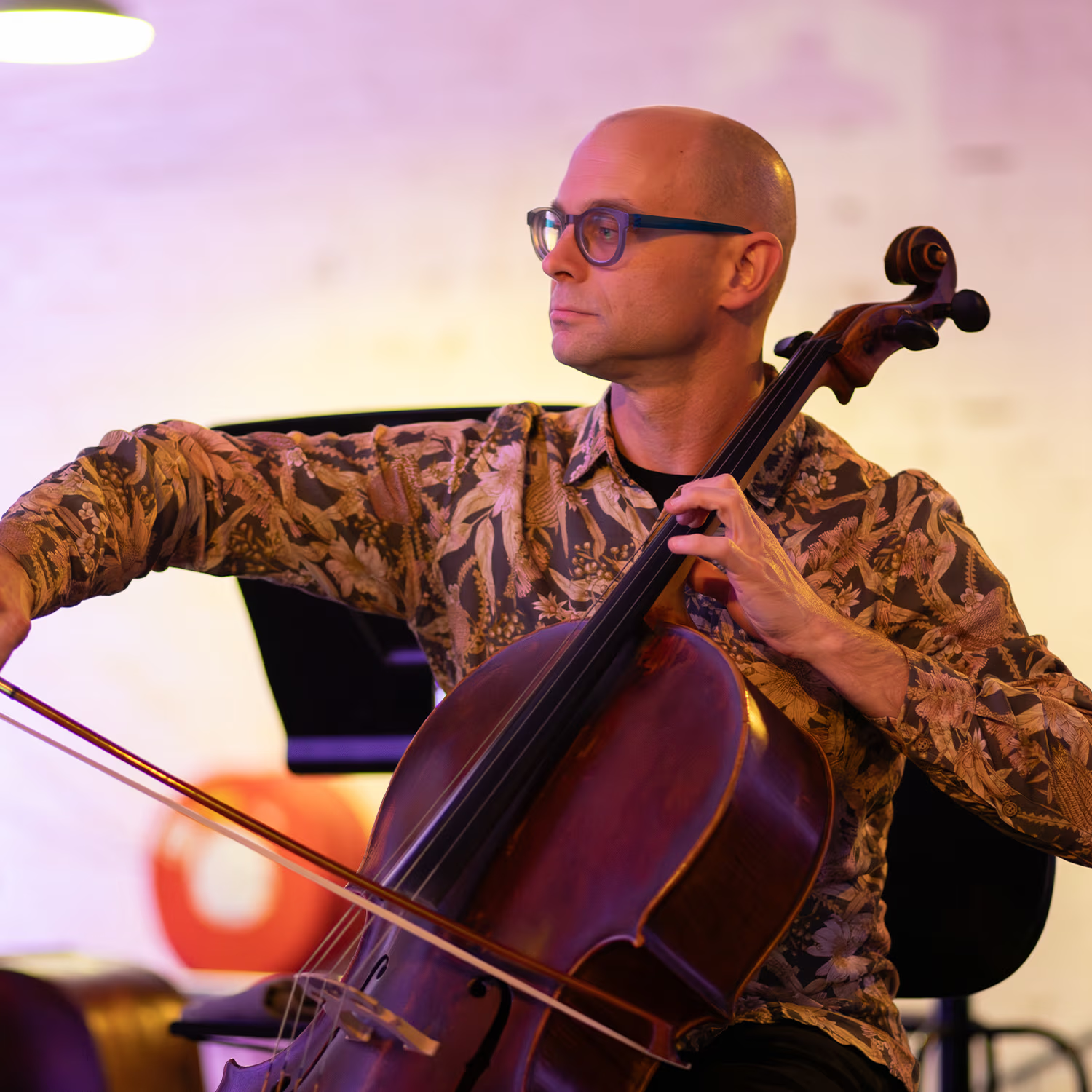
Cello
Jonathan Békés Principal
Alexandra Békés
Ivan James
Nicholas McManus
Sophie Radke
Oliver Russell
Double Bass
Stuart Thomson Principal
Matthew McGrath
James Menzies
Stuart Riley
Flute
Lily Bryant Guest Principal
Maria Hincapie Duque
Lloyd Hudson Principal Piccolo
Oboe
Rachel Bullen Guest Principal
Alexandra King
Dinah Woods Principal Cor Anglais
Clarinet
Andrew Seymour Principal
Eloise Fisher Principal Bass Clarinet
Bassoon
Tahnee van Herk Principal
Melissa Woodroffe Principal Contrabassoon
Horn
Greg Stephens Principal First
Claudia Leggett Principal Third
Roger Jackson
Julian Leslie
Trumpet
Fletcher Cox Guest Principal
Mark Bain
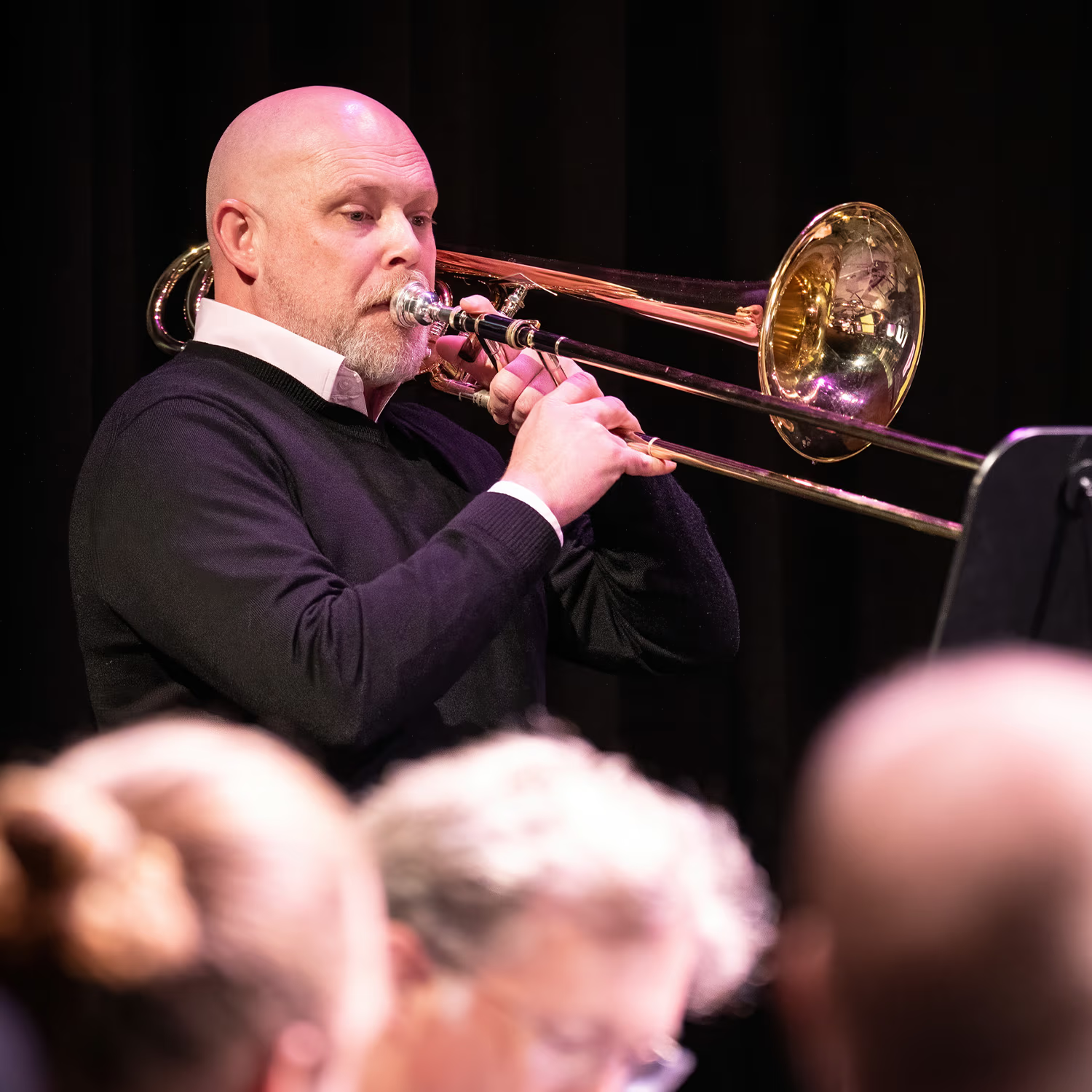
Trombone
David Robins Principal
Jackson Bankovic
Bass Trombone
James Littlewood Principal
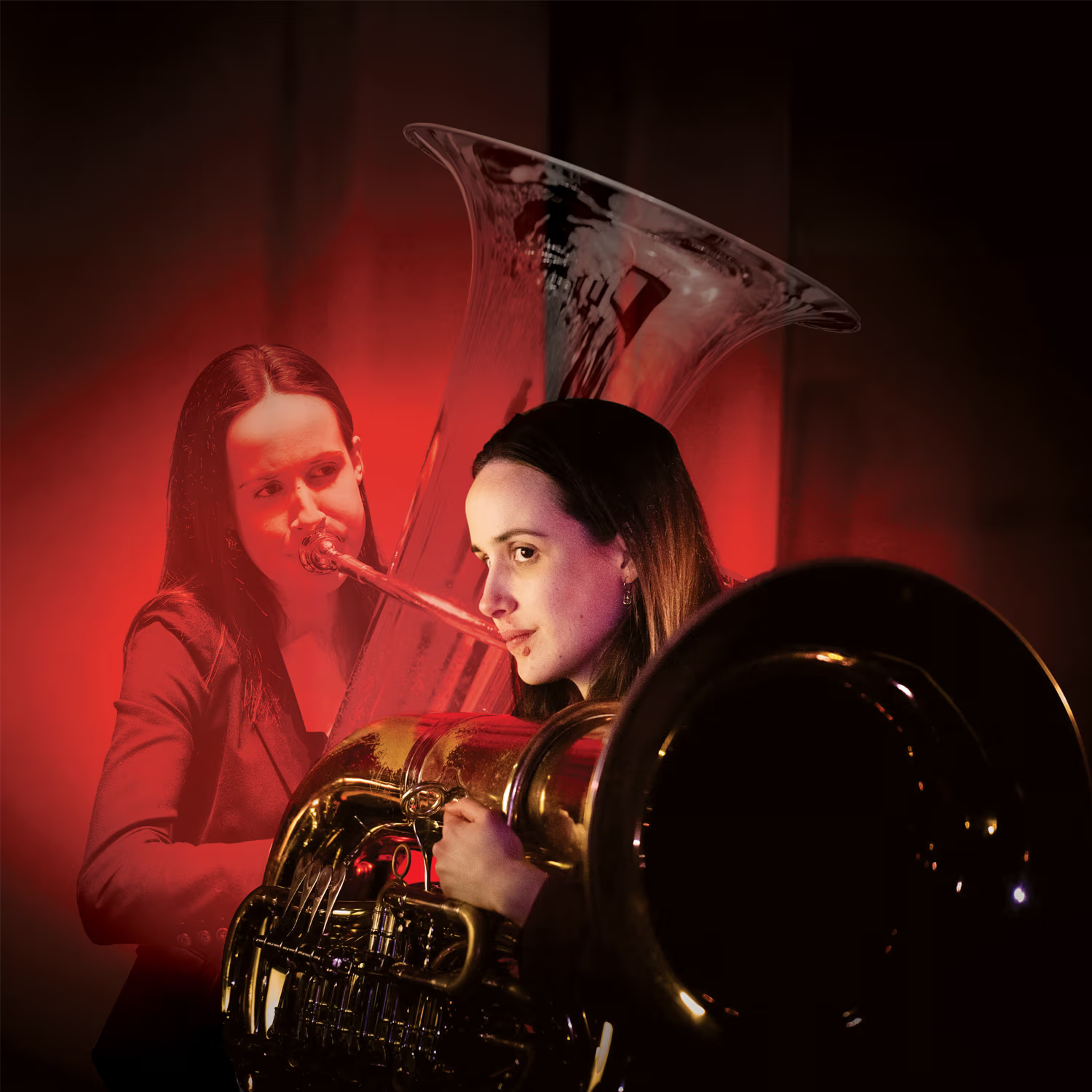
Tuba
Rachel Kelly Principal
Timpani
Matthew Goddard Principal
Percussion
Gary Wain Principal
Robert Allan
Matthew Brennan
Tracey Patten
Harp
Meriel Owen Guest Principal
Piano
Karen Smithies Guest Principal
*Correct at time of publishing
Photo credit: Fin Matson

Everything you need to know about Federation Concert Hall.

Hotel Offers from Hadley's Orient Hotel
Nestled among other architectural masterpieces in Hobart's city centre, this heritage-listed hotel plays host to almost two centuries of stories, scandals and secrets. The floor boards whisper of the hotel’s rich and often tumultuous history.

What are acoustics and how do they affect my concert experience?
Acoustics are the science of sound, or the way a venue can deliver the thunderous feeling of strings and brass, or the ring of the triangle over all the other instruments.
Read more about the acoustics of the Hall here.
Featuring Ji Won Kim on violin, Caleb Wright on viola and TSO Chief Conductor Eivind Aadland.
Rossini William Tell, Overture
Mozart Sinfonia Concertante for Violin and Viola in E flat, K364
Shostakovich Symphony No 15 in A, Op 141
Whether sponsoring a musician in the orchestra, or supporting our invaluable community programs, so much of what we do relies on you. We offer our deepest thanks to all our Partners, Patrons and Friends.
Support the TSO and connect with our orchestra beyond the concert hall.
Huon Pine Patrons
John Cauchi AM & Catherine Walker Chair Patrons
Anne & Don Challen AM Chair Patrons
Jane Drexler
Rob & Tricia Greenwell Chair Patrons
David & Catherine Hamilton Chair Patrons
Marie Heitz Chair Patron
In Memory of Ian Hicks Chair Patron
Belinda Kendall-White Chair Patron
Patricia Leary Chair Patron
Penny Le Couteur & Greg Dickson
Ang Madden Chair Patron
Emma & Dom McNamara
Mountain Air Foundation Chair Patron
R H O'Connor
Andrew Parker & Caroline Sharpen Chair Patrons
Chris & John Sandow Chair Patrons
Dr Peter Stanton Chair Patron
TasPlates
Dr Hilary Wallace Chair Patron
Anonymous (2)
TSO Concertmaster Emma McGrath plays an 1845 Jean-Baptiste Vuillaume violin on loan from two of our generous Tasmanian patrons.
Sassafras Patrons
Cath Adams & Steve Craft Chair Patrons
Damian Bugg AM & Jenny Bugg
John & Marilyn Canterford
Dr Joanna de Burgh
Marc & Susan Duldig Chair Patrons
Richard & Harriett England
Emeritus Prof Andrew Glenn & Dr Odile Glenn Chair Patrons
Elizabeth Haworth & John Diment Chair Patrons
Suzanne Kirkham
John Langford
Diane Matthews
Anthony G McGee AM Chair Patron
Louise & Tim Mooney AM Chair Patrons
Bruce Neill & Penny Clive Chair Patrons
Bill Oakley OAM Chair Patron
Jan & Alan Rees Chair Patrons
Dr David & Mrs Glenys Rich Chair Patrons
Dr John & Mrs Barbara Roberts
James and Jacqueline Roberts-Thomson Chair Patrons
Rotary Satellite Club of Sandy Bay, Battery Point
Dr Di Stow Chair Patron
Michelle Warren
Deirdre & Trevor Wise
Anonymous (3)
Leatherwood Patrons
Andrew Bennett
Suzanne & Martin Betts
Peter Brooks
Elizabeth Bugg
Janet Carding
Helen Carrig
George & Jan Casimaty
Dr Josh & Wendy Cocker
Prof Mike Coffin
Beth Coombe
Stephanie Cooper
Simon Coultas
Vicki Cowles & Josef Neuschwanger
Nick & Janet Cretan
Emeritus Prof Stephen Crump
David Davey & Annick Ansselin
Allanah Dopson
Roger Fisher
TJ Foster
Giameos Constructions & Developments
Mr Tony Hagar
Amelia Hagger
Ms Keri Handley & Mr Frank Martin
Susan Hawick AM
Dr Donald Hempton
Peter & Jeanne Hepburn
Janet Holmes à Court AC
Dr David & Donna Humphries
Don & Christine Jeffrey
Prof Matthew Jose
Paavo Jumppanen
Veronica Keach
Judith Ker
Yury Kudryavtsev
Betty Kuhl
Harvey Lennon
David Lloyd
Marilla Lowe
Linda & Martin Luther
Dr Katherine Marsden
Maggie McKerracher
Margret Monks
Sarah Morrisby
Professor Robert Morris-Nunn
Alison Nadebaum
Jan Nicholas
Sindi O'Hara & Peter Pickett
Alison E Parsons
Catherine Prideaux
Helen Ross & Margaret Whiteside
Margaret Sallis
Deirdre Schoe
Dr Johannes Schonborn
Jenny Scott
Dick & Sue Shoobridge
Christopher Spiegel
Tony Stacey AM & Mrs Jeanette Stacey
Mr Ken Stanton
Janet Tomlinson
Rowland Turner
Frances Underwood
John Usher OAM
Hank & Elizabeth van Herk
Kim Waldock
Jacqui Walkden
Dr Michael Wilkinson
Geoff & Vicki Willis
Lindsay & Rae Young
Jane Zimmerman
Anonymous (7)
Blackwood Patrons
Simon Allston & Janeil Hall
Jacqui Blowfield
Kim Boyer
Dr Nicholas Brodie
Robert and Lisa Brodribb
Deborah Brook
Cameron Bryer
Jenny & Ian Burleigh
Victoria Burley
Roger Carrington
Dr Helen Chick
Heather & Christopher Chong
Gail Cork
Janet Crane
Amy Crosby
Jane Edmanson OAM
Ms Gail Friesen
Dr Brita Hansen & Frank Halley
Susie Harrison
Shirley Honeysett
Peter Hordern
Ross Kelly
Mary Ellen i m Kerensa
Richard & Julia Metcalf
Gisele O'Byrne AM
Tony Purdon
School for Seniors Rosny
John Sexton
Dr Tanya Stephens
Priscilla Travers
Jeanette Tremayne
Residents of Vaucluse Gardens
Judith Waldock
Jane Wilcox
Polly Woods
Dr Rosemary Yeoland
Anonymous (9)
Silver Wattle Patrons
Trevor & Barbara Abbott
Michael Alchin
Chris Andrews & Jill-Maree Geeves
May Backhouse
Dennis Bewsher
Dixie Brodribb
Elizabeth Chelkowska
Christine Coombe
G. D. Couninis
Tony & Kate Dell
Heather Ebbott
Sam Finlay
Sari Goddam
John Heathcote & Mary Feeley
Sharron Hewer
Ann Hopkins
Linda Jackson
Peter Jarvis & Ans van Heijster
Louise Klein
Sue Kremer
Ted Lefroy
Chris & Dot Lloyd-Bostock
William Lo
Rose & Thomas Marwick
Sandra Michael
Jane Monaghan
Dr Robyn Munro
Meriel Owen
Leone Paget
Shefali Pryor
Springhaven Lifestyle Village
Grant & Elizabeth Taylor
Diane & Neville Truskett
Judith and Rod Tudball
Julian Type
Dr Johanna Wadsley
Dr Roland Warner
Christopher Waterhouse
Anonymous (12)
Chat with one of our friendly staff at the TSO Box Office.