Concert Program

Beethoven’s First

Saturday 18 Oct 2025 7:30pm
Federation Concert Hall, Nipaluna / Hobart

Looking for tickets? Go here.

Beethoven and folk music,
but through the eyes of
boundary-pusher Pekka
Kuusisto.
Close-up of a musician in a dark suit playing a violin under stage lights, with blurred sheet music visible in the foreground.

The Tasmanian Symphony Orchestra acknowledges the traditional owners and continuing custodians of Lutruwita / Tasmania. We pay respect to the Aboriginal community today, and to its Elders past and present. We recognise a history of truth, which acknowledges the impacts of colonisation upon Aboriginal and Torres Strait Islander people and stand for a future that profoundly respects their stories, culture, language and history.

About the concert

Works

Rautavaara Pelimannit (The Fiddlers) Op 1 (8 mins)

5 movements

  1. Närböläisten braa speli (The Närbö Villagers in Fine Fettle)
  2. Kopsin Jonas (Mr Jonas Kopsi)
  3. Klockar Samuel Dikström (Bell-ringer Samuel Dikström)
  4. Pirun polska (Devil’s Polka)
  5. Hypyt (Jumps)

Clyne Time and Tides* (28 mins)

5 movements

  1. The True Lover’s Farewell
  2. Who Can Sail Without Wind?
  3. My Fair Young Love
  4. The Golden Willow Tree
  5. Farewell

* Co-commissioned by the Tasmanian Symphony Orchestra with thanks to private donors.

20 minute interval

Beethoven Symphony No 1 in C, Op 21 (26 mins)

4 movements

  1. Adagio molto – Allegro con brio
  2. Andante cantabile con moto
  3. Menuetto. Allegro molto e vivace
  4. Adagio – Allegro molto e vivace

💡 Stabat Mater

Find the Latin text and translation here.

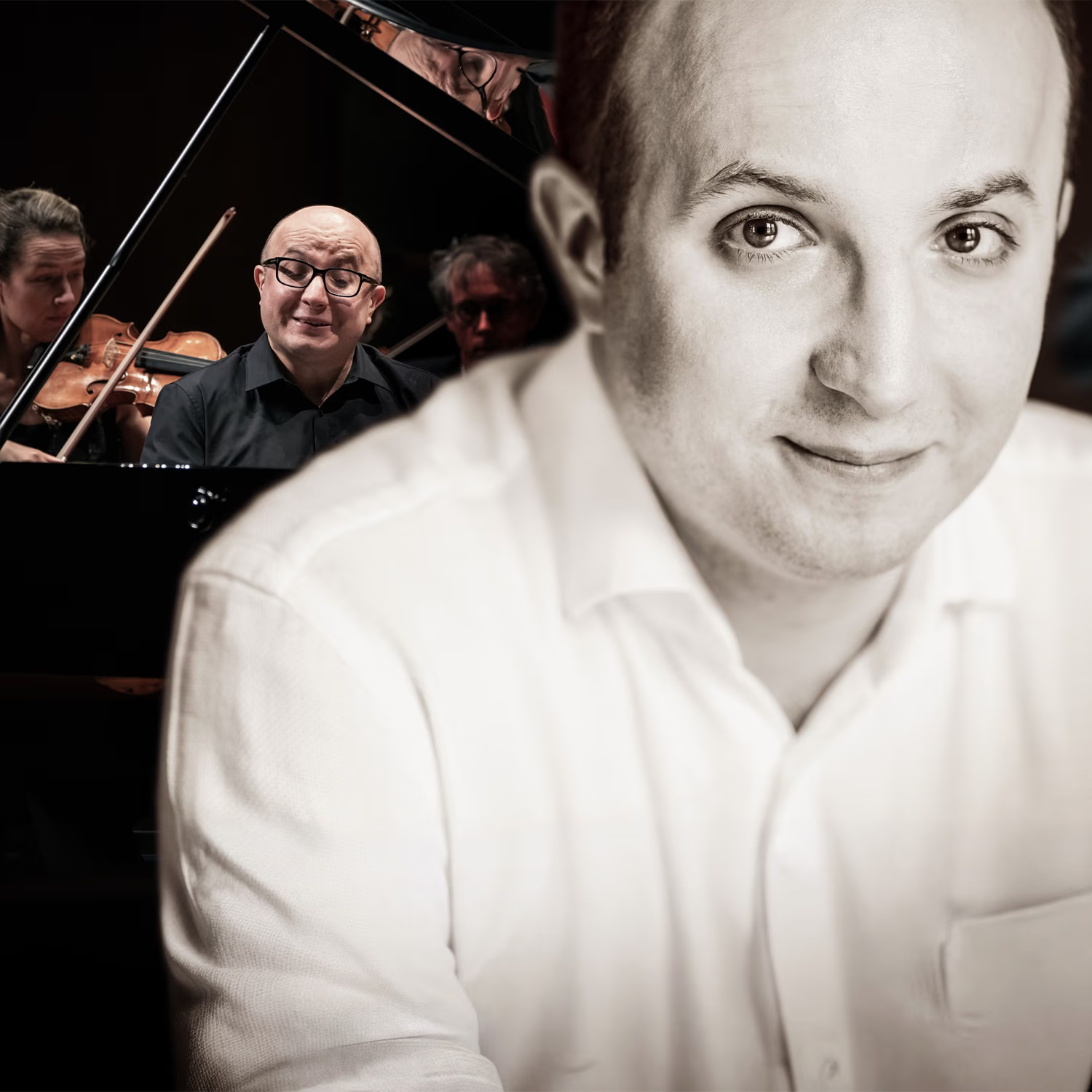
Pekka Kuusisto, conductor and violinist. Image credit: Bard Gundersen.

Pekka Kuusisto, conductor and violinist.
Image credit: Bard Gundersen.

Concert 101: Learn about the works being performed

For the enjoyment of all in the concert hall, please only watch Concert 101 before or after the performance. 

Uncover the stories behind the works.

Rustic. Playful. Magical.

Pelimannit (The Fiddlers) Op 1

  1. Närböläisten braa speli (The Närbö Villagers in Fine Fettle)
  2. Kopsin Jonas (Mr Jonas Kopsi)
  3. Klockar Samuel Dikström (Bell-ringer Samuel Dikström)
  4. Pirun polska (Devil’s Polka)
  5. Hypyt (Jumps)

Composed by Einojuhani Rautavaara (1928–2016)

8 minutes

Einojuhani Rautavaara (1928–2016) is widely regarded as Finland’s most important composer after Sibelius. Known later in life for lush, mystical orchestral scores, he began his career with works that drew strongly on folk traditions. Pelimannit (The Fiddlers), written in 1952 when he was just 24, is his official Opus 1 – the work with which he introduced himself to the musical world.

The inspiration came from a collection of fiddle tunes by Samuel Rinda-Nickola, a 19th-century folk violinist from Ostrobothnia, in western Finland. Rautavaara was struck not only by the earthy vitality of these melodies, but also by the characterful names Rinda-Nickola had given them – titles such as The Fiddler’s Funeral March or Devil’s Polka. Rather than present the tunes in their raw form, Rautavaara arranged and reimagined them in his own fresh style, sometimes spiky and witty, sometimes lyrical and melancholy.

Originally written for piano and later arranged by the composer for string orchestra, the suite consists of five short movements, each based on one of Rinda-Nickola’s tunes. Listeners will hear rustic dance rhythms, foot-stomping energy, and sudden mood changes that evoke the spirit of village musicians. Yet beneath the surface lies a young composer’s sharp ear for colour and atmosphere. Even in this early score, one senses Rautavaara’s gift for turning simple material into something magical and larger than life.

Pelimannit has become one of Rautavaara’s most performed works. It speaks directly and vividly, needing no special knowledge of Finnish folk culture to enjoy. The music celebrates the fiddlers who kept these tunes alive, while also marking the beginning of Rautavaara’s long journey as a composer – a journey that would eventually lead to some of the most haunting and spiritual orchestral music of the late 20th century.

Boats, the ocean, and true love.

Time and Tides

  1. The True Lover’s Farewell
  2. Who Can Sail Without Wind?
  3. My Fair Young Love
  4. The Golden Willow Tree
  5. Farewell

Composed by Anna Clyne (b.1980)

28 minutes

💡 FIRST-TIMER TIP

The names of movements in symphonies often follow traditional conventions that give insight into the character, tempo, and sometimes the form of each section.

These terms not only instruct performers on the tempo and mood of each movement but also guide listeners through the emotional and narrative arc of the symphony. For example, ‘Allegro’ refers to tempo and ‘molto’ translates to very, so: very fast!

Anna Clyne (b. 1980) is a Grammy-nominated British composer whose music is celebrated for its emotional depth, vivid colour, and imaginative blending of acoustic and electronic sounds. Her works range from intimate chamber pieces to large-scale orchestral scores, often inspired by visual art, literature, and personal reflection. Clyne has served as composer-in-residence with ensembles including the Chicago Symphony Orchestra and the Baltimore Symphony Orchestra, and her music has been performed by leading orchestras around the world. Collaborating closely with conductors and soloists, she creates music that is both modern and deeply human. Her works such as Within Her Arms, Night Ferry, and DANCE have established her as one of the most distinctive voices in contemporary classical music.

Time and Tides was co-commissioned by the Helsinki Philharmonic Orchestra, Detroit Symphony Orchestra, Scottish Chamber Orchestra, Swedish Chamber Orchestra, and Tasmanian Symphony Orchestra. Its world premiere was given by Pekka Kuusisto with the Helsinki Philharmonic Orchestra on 8 September 2023.

From the composer:

Set in five movements, Time and Tides is inspired by four folk tunes:

My True Lover’s Farewell – from England
Who Can Sail Without Wind? – from Finland
My Fair Young Love – from Scotland
The Golden Willow Tree – from America

This collection of folk songs explores themes of boating, the oceans and parting from loved ones. Each movement begins with a statement of the folk tune in its original form and I then spin it out through my own lens – harmonising, orchestrating and expanding upon the source material to create new narratives. The fifth and final movement, titled Farewell, weaves together elements of all four folk tunes heard in the previous movements. Time and Tides is dedicated to violinist Pekka Kuusisto. Special thanks to musicians Bruce Molsky and Aidan O’Rourke for sharing folk tunes from their native countries.

Elegant. Spirited. Groundbreaking.

Symphony No 1 in C, Op 21

  1. Adagio molto – Allegro con brio
  2. Andante cantabile con moto
  3. Menuetto. Allegro molto e vivace
  4. Adagio – Allegro molto e vivace

Composed by Ludwig van Beethoven (1770–1827)

26 minutes

When Beethoven’s Symphony No 1 in C major was premiered in Vienna in 1800, audiences were introduced to a new voice in symphonic music. At the time, Beethoven was known primarily as a brilliant pianist and a student of Haydn, but this symphony marked his bold step into a form dominated by his predecessors. Though it follows the Classical model of Haydn and Mozart, it already reveals flashes of Beethoven’s originality and wit.

Right from the start, he unsettles expectations: the symphony begins not in C major, as the title suggests, but with a series of chords that wander through other keys before finally arriving at the home key. It’s a musical joke — playful, confident, and slightly rebellious. The first movement is bright and energetic, while the second offers graceful lyricism. The third movement, labelled Menuetto, moves with a speed and drive that clearly point toward the Beethoven scherzos to come. The finale bursts forth with humour and exuberance, showcasing the composer’s rhythmic vitality and sense of surprise.

Underneath the elegance and clarity typical of the Classical period, this symphony hints at the power and invention that would later define Beethoven’s mature works. It captures the spirit of a young artist eager to make his mark – respectful of tradition, but determined to stretch its boundaries.

In his first symphony, we hear Beethoven at the threshold of his revolutionary career: playful yet purposeful, refining the symphonic form even as he begins to reshape it. The result is a work that bridges two eras: the elegance of the Classical world, and the daring individuality of the Romantic age that Beethoven would soon lead.

Tender. Radiant. Devotional.

Stabat Mater

Composed by Gioachino Rossini (1792-1868)

62 minutes

Gioachino Rossini is best remembered for his dazzling operas, but his Stabat Mater shows a different side of his artistry. Written in the 1830s and completed in 1841, the work sets a 13th-century Latin hymn that describes the Virgin Mary’s grief as she stands at the foot of the cross. For centuries this text has inspired composers, but Rossini brings his own unmistakable voice – dramatic, lyrical, and full of colour.

The Stabat Mater has an unusual history. Rossini began the piece while travelling in Spain in 1831, composing six movements before ill health forced him to hand the remaining sections to a colleague. For years the work existed in this mixed form, but Rossini later returned to complete the music himself. The final version was first performed in Paris in 1842 and was immediately hailed as a triumph.

The score alternates between large, powerful movements for chorus and orchestra, and more intimate arias and ensembles for the four soloists. Listeners encounter music that shifts effortlessly between sacred solemnity and operatic intensity. At times the music is hushed and devotional, at other times it soars with passion, reflecting both the suffering and the hope contained in the text.

Rossini’s operatic background is never far from the surface – there are moments of theatrical flair, lyrical melodies, and dramatic contrasts that would not be out of place on the stage. Yet beneath the brilliance lies genuine feeling, a deep response to one of the most moving texts in the Christian tradition.

The Stabat Mater remains a unique achievement: a sacred work that combines heartfelt devotion with the expressive power of the theatre.

Enjoying the concert?

Rewatch all your favourite moments on TSO On Demand.

Streaming sixteen concerts from Federation Concert Hall, this is the full orchestra at its brilliant best.

Tasmanian Symphony Orchestra on stageTasmanian Symphony Orchestra on stage

Start Watching

Musicians

Pekka Kuusisto

Conductor & Violinist

Supported by Anonymous

Pekka Kuusisto. Image credit: Bard Gundersen.

Pekka Kuusisto. Image credit: Bard Gundersen.

Violinist, conductor, and composer Pekka Kuusisto is renowned for his artistic freedom and fresh approach to repertoire. Kuusisto is Artistic Director of Norwegian Chamber Orchestra and Principal Guest Conductor & Artistic Co-Director of Helsinki Philharmonic Orchestra. He is also a Collaborative Partner of San Francisco Symphony, and Artistic Best Friend of Die Deutsche Kammerphilharmonie Bremen.

Kuusisto performs with renowned orchestras worldwide including the Mahler Chamber Orchestra, Leipzig Gewandhaus Orchester, Los Angeles Philharmonic, NHK Symphony Orchestra Tokyo and Boston Symphony Orchestra. He conducts Deutsches Symphonie-Orchester Berlin, Tokyo Metropolitan Symphony Orchestra, Gothenburg Symphony Orchestra, Scottish Chamber Orchestra, Swedish Chamber Orchestra, Orchestre de chambre de Paris and Berliner Philharmoniker.

Kuusisto is an enthusiastic advocate of contemporary music and a gifted improviser and regularly engages with people across the artistic spectrum. Uninhibited by conventional genre boundaries and noted for his innovative programming, recent projects have included collaborations with Hauschka and Kosminen, Dutch neurologist Erik Scherder, pioneer of electronic music Brian Crabtree, eminent jazz-trumpeter Arve Henriksen, juggler Jay Gilligan, accordionist Dermot Dunne and folk artist Sam Amidon. As Council, Kuusisto tours North America and Australia with American singer-songwriter Gabriel Kahane.

Eleanor Lyons

Soprano

Eleanor Lyons. Soprano.

Australian soprano Eleanor Lyons is celebrated for her versatility, deep musicality, and fresh interpretations across opera, orchestral concerts, chamber music and solo recitals. Her artistry has led to ongoing collaborations with leading conductors and orchestras worldwide.

Recent highlights include her acclaimed house debut at Dresden’s Semperoper as Leonore in Beethoven’s Fidelio in Christine Mielitz’s historic production, followed by performances of the same role with the Orquesta y Coro Nacionales de España under David Afkham. She also toured Europe with Philippe Herreweghe and the Orchestre des Champs-Élysées as soloist in Beethoven’s Ninth Symphony.

In Australia, Eleanor has appeared with the Queensland Symphony in Strauss’ Four Last Songs and Beethoven’s Ninth under Umberto Clerici, made her Sydney Symphony debut as Freia in Wagner’s Das Rheingold with Simone Young, and sang Verdi’s Requiem at the Adelaide Festival with the Antwerp Symphony. Internationally, she debuted with the MDR Symphony in Vaughan Williams’ Sea Symphony under Dennis Russell Davies, appeared at the Vienna Musikverein in Bruckner’s Psalm 150 with the Vienna Symphony under Petr Popelka, and performed Beethoven’s Missa Solemnis at the Festival Les Chorégies d’Orange with John Nelson.

The 2024–25 season brings her debut with the Deutsche Radio Philharmonie in Britten’s Les Illuminations and Mozart concert arias, and her first appearance at Turin’s Teatro Regio in Mahler’s Second Symphony with Aziz Shokhakimov. She returns to the Queensland Symphony for Verdi’s Requiem, and continues her collaboration with Philippe Herreweghe in a European tour of Beethoven’s Ninth. Further debuts include Dvořák’s Stabat Mater with the Rundfunk-Sinfonieorchester Berlin, Poulenc’s Stabat Mater with the City of Birmingham Symphony (Kazuki Yamada), Mahler’s Second Symphony with the Melbourne Symphony (Jaime Martin), and Rossini’s Stabat Mater with the Tasmanian Symphony (Valentina Peleggi) .

Eleanor studied at the Royal Northern College of Music and the Mariinsky Academy, and won first prize at the International Obraztsova Singing Competition.

Sian Sharp

Mezzo-soprano

Supported by Anonymous

Image

Dynamic Australian mezzo-soprano Sian Sharp has been described as “one of Opera Australia’s most versatile and accomplished singers” (Australian Arts Review) .

In 2023 she returned to Opera Australia in signature roles including Suzuki (Madama Butterfly), Giovanna and Maddalena (Rigoletto), and appeared as La Muse in Damiano Michieletto’s new production of The Tales of Hoffmann. She also sang in Sydney Philharmonia’s performance of Mahler’s Symphony No 8.

Her 2024 engagements include Dodo (Breaking the Waves), La Zelatrice (Suor Angelica), and Second Lady (The Magic Flute) with Opera Australia, while covering Idamante (Idomeneo) and Gertrude (Hamlet). On the concert stage she appears as Rossweisse (Die Walküre) with the Sydney Symphony, in Haydn’s Harmoniemesse with the Tasmanian Symphony, and in Mendelssohn’s Elijah with Sydney Philharmonia.

A long-standing member of Opera Australia, Sian’s repertoire spans more than 30 roles, including Carmen (Carmen), Amneris (Aida), Dorabella (Così fan tutte), Rosina (Il barbiere di Siviglia), Cherubino and Marcellina (Le nozze di Figaro), Olga (Eugene Onegin), Federica (Luisa Miller), Arsace (Partenope), Hansel (Hansel and Gretel), Suzuki (Madama Butterfly), and Waltraute and Siegrune in Der Ring des Nibelungen. She has also appeared in Il viaggio a Reims, Don Quichotte, Romeo and Juliet, Otello, Cavalleria rusticana, Il trovatore, La clemenza di Tito, Mefistofele, Rusalka and Salome.

In concert, Sian has performed with the Sydney Symphony in Mendelssohn’s A Midsummer Night’s Dream and as Mary in Wagner’s The Flying Dutchman with the Melbourne Symphony. She has also sung Handel’s Messiah with the Queensland Symphony and appeared frequently with Sydney Philharmonia in works including Bach’s St John Passion, Mendelssohn’s Elijah, and Elgar’s The Dream of Gerontius.

Matteo Desole

Tenor

Supported by Anonymous

Image

Born in Sassari in 1989, Italian tenor Matteo Desole began his vocal studies in 2013 with Raina Kabaivanska in Modena. He first appeared as soloist in Schnittke’s Requiem (2007) and Schubert’s Mass in B-flat (2011), and has sung widely in concert, drama, and opera, including Leopold in La parrucca di Mozart and roles with Cooperativa Teatro e/o Musica di Sassari. In 2012 he won a scholarship at the International Lyric Competition “G. Martinelli – A. Pertile” and has collaborated frequently with the Luciano Pavarotti Foundation.

Desole made his operatic debut as Malcolm in Macbeth at Teatro Comunale Bologna under Roberto Abbado in a production by Bob Wilson. Rapidly establishing himself in leading roles, he has since sung the Duke in Rigoletto (As.Li.Co), Edgardo in Lucia di Lammermoor (Savona, Cagliari), Alfredo in La traviata (Rome Opera in Sofia Coppola’s production, Tiroler Festspiele Erl, Holland Park, Tokyo, Venice, Florence), Tamino in Die Zauberflöte, Rodolfo in La bohème (Erl, Klagenfurt, Savona, Prague, Bari, Copenhagen), Ruggero in La rondine (Florence), and Rinuccio in Gianni Schicchi (Modena, Ferrara, Reggio, Piacenza).

He has appeared at major houses including La Scala, where he debuted in Francesca da Rimini under Fabio Luisi and later performed in I masnadieri (Milan and Savonlinna Festival). Other engagements include Simon Boccanegra (Genoa), Donizetti’s Requiem (Modena), Ernani (Vilnius, Rome), Tosca (Savona, Prague), and Un ballo in maschera (Cluj, Klagenfurt).

Praised for his lyrical tone and dramatic presence, Desole continues to expand his repertoire across Italy and internationally, performing regularly with leading conductors and directors.

Jeremy Kleeman

Bass Baritone

Supported by Anonymous

Jeremy Kleeman. Bass baritone.

Winner of the Australian International Opera Award and Dame Heather Begg Memorial Award, Melbourne-born bass-baritone Jeremy Kleeman is a graduate of London’s Royal College of Music and a former Sambrook Scholar with Melba Opera Trust.

In 2025 he makes role debuts as Schaunard (La bohème) with Opera Queensland and Abimelech (Samson and Delilah) with Melbourne Opera, creates the role of Captain Gibb in Cassomenos and Gething’s new opera Eva for the Port Fairy Spring Music Festival, and appears as bass soloist in Rossini’s Stabat Mater with the Tasmanian and New Zealand Symphony Orchestras. Other concert engagements this year include Purcell’s Ode on St Cecilia’s Day at the Woodend Winter Arts Festival and Bach’s St John Passion with the Melbourne Bach Choir.

Last year Jeremy created the title role in Jack Symonds’ Gilgamesh for Opera Australia and Sydney Chamber Opera, praised for his “rich, effortlessly noble bass-baritone” (The Saturday Paper). A champion of new Australian opera, he has also originated roles in George Palmer’s Cloudstreet, Elliot Gyger’s Oscar and Lucinda, Calvin Bowman’s The Magic Pudding, and Curtis and Gow’s Voyage to the Moon.

Other recent highlights include Guglielmo (Così fan tutte) with Opera Queensland, Figaro (Le nozze di Figaro) with Opera Queensland, West Australian Opera, State Opera South Australia and Opera Australia’s National Tour, and Captain Corcoran (HMS Pinafore) with State Opera South Australia.

On the concert stage, Jeremy has sung Handel’s Messiah with the Tasmanian and Melbourne Symphony Orchestras, Nielsen’s Symphony No 3 and Rossini’s Petite messe solennelle with the MSO, and gala performances with the Queensland and Canberra Symphony Orchestras. Internationally, he has performed in Elgar’s The Apostles with the London Philharmonic Choir and Orchestra, with the London Handel Players at the Tilford Bach Festival, as Traveller in Britten’s Curlew River in Moscow, and in recital at Norway’s Northern Lights Festival.

Tonight’s orchestra

Eivind Aadland Conductor

James Ehnes Violin

Tasmanian Symphony Orchestra

Violin

Emma McGrath Concertmaster 

Ji Won Kim Associate Concertmaster 

Tobias Chisnall Principal Second

Rohana O'Malley Principal First

Kirsty Bremner

Miranda Carson

Yue-Hong Cha

Margaret Connolly

Frances Davies

Christine Lawson

Elinor Lea

Xinyu Mannix

Christopher Nicholas

Hayato Simpson

💡 FIRST-TIMER TIP

Did you know our Concertmaster plays a violin hand-crafted by one of the finest and most important luthiers (a string-instrument maker) of the nineteenth century, Jean-Baptiste Vuillaume (1798–1875).

He crafted 3000+ instruments in his time and we’re very proud to have a violin made in 1845 on loan from two of our generous Tasmanian patrons.

Viola

Caleb Wright Principal

Douglas Coghill

Anna Larsen Roach

William Newbery

Karina Schmitz

Cello

Jonathan Békés Principal

Ivan James

Nicholas McManus

Martin Penicka

Double Bass

Stuart Thomson Principal

Matthew McGrath

Harry Young

Flute

Lily Bryant  Guest Principal

Lloyd Hudson  Principal Piccolo

Oboe

Rachel Bullen Guest Principal

Dinah Woods Principal Cor Anglais

Clarinet

Andrew Seymour Principal

Eloise Fisher Principal Bass Clarinet

Bassoon

Tahnee van Herk Principal

Melissa Woodroffe Principal Contrabassoon

Horn

Claudia Leggett Principal First

Hannes Kaukoranta

Trumpet

Fletcher Cox Principal

Mark Bain

Trombone

David Robins Principal

Jackson Bankovic

Jack Machin

Bass Trombone

James Littlewood Principal

Tuba

Rachel Kelly Principal

Timpani

Matthew Goddard Principal

Percussion

Gary Wain Principal

Tracey Patten

Harp

Meriel Owen Guest Principal

Piano

Karen Smithies Guest Principal

Celeste

Jennifer Marten-Smith Guest Principal

Saxophone

Jabra Latham Guest Principal

Benjamin Price Guest Principal

Organ

Nathan Cox Guest Principal

TSO Chorus

Warren Trevelyan-Jones Chorus Master

Karen Smithies Repetiteur

Soprano

Christine Coombe

Linda Coombes

Ruth Croser

Felicity Gifford

Yuliana Hammond

Lauren Hill

Kasia Kozlowska

Bernadette Large

Loretta Lohberger

Erin Murphy

Schuya Murray

Christine Ovens

Susannah Rawlinson

Chantal Roddy

Carolyn Seelen

Joy Tattam

Lesley Wickham

Alto

Nadeena Beck

Claire Blichfeldt

Beth Coombe

Elizabeth Eden

Ann Godber

Sue Harradence

Michelle Harris

Mary Harwood

Caroline Miller

Rosemary Rayfuse

Karen Sloane

Gillian von Bertouch

Beth Warren

Andrea Wild

Tenor

Helen Chick

Phillip Clutterbuck

Michael Kregor

Bill MacDonald

Tony Marshall

Mandy McKendrick

Dianne O’Toole

David Pitt

James Powell-Davies

Peter Tattam

Bass

Geoffrey Attwater

John Ballard

Tim Begbie

Roy Classey

Peter Cretan

Jack Delaney

Liam Filby

Greg Foot

Peter Hepburn

Michael Muldoon

David Ovens

Tony Parker

Philip Ridyard

Grant Taylor

Tane Thomas

*Correct at time of publishing

Return to Navigation →

Federation Concert Hall

Our Southern Home

Federation Concert Hall has been our home since 2001. It's distinctive curve, golden Tasmanian timber, contemporary design and deep red seats set the tone for the ultimate concert experience. 
 
In 2020, major acoustical enhancements were made to the hall, amplifying the venue's, and the TSO's, reputation as world-class. 

Photo credit: Fin Matson

💡 FIRST-TIMER TIP

A 'movement' is a longer piece of music broken up into bite-size pieces. It makes it easier to perform and provides contrast within the work. Find out more here.

Orchestra performing in Federation Concert Hall.

Getting THere & Accessibility

Everything you need to know about Federation Concert Hall.

Find Out More
Hadley's Orient Hotel

Make it an experience

Hotel Offers from Hadley's Orient Hotel

Nestled among other architectural masterpieces in Hobart's city centre, this heritage-listed hotel plays host to almost two centuries of stories, scandals and secrets. The floor boards whisper of the hotel’s rich and often tumultuous history.

Federation Concert Hall

💡 FIRST-TIMER TIP

What are acoustics and how do they affect my concert experience?

Acoustics are the science of sound, or the way a venue can deliver the thunderous feeling of strings and brass, or the ring of the triangle over all the other instruments.

Read more about the acoustics of the Hall here.

Karen Gomyo

Coming up

Karen Gomyo

Sparks will fly, featuring Karen Gomyo.

Delius The Walk to the Paradise Garden
Dvořák Violin Concerto in A minor, Op 53
Robert Schumann Symphony No 1 in B-flat, Op 38, ‘Spring’

Two women in black attire sing passionately in a choir performance, holding sheet music as they stand among other vocalists in a concert setting.

Coming up

The Creation

Featuring soprano Samantha Clarke, tenor Michael Petruccelli, baritone Morgan Pearse and the TSO Chorus, with TSO Chief Conductor Eivind Aadland.

Joseph Haydn Die Schöpfung (The Creation)

Find Out More

Our supporters

Whether sponsoring a musician in the orchestra, or supporting our invaluable community programs, so much of what we do relies on you. We offer our deepest thanks to all our Partners, Patrons and Friends.

Support the TSO and connect with our orchestra beyond the concert hall.

Donate Now
5G Networks

Huon Pine Patrons

John Cauchi AM & Catherine Walker Chair Patrons

Anne & Don Challen AM Chair Patrons

Jane Drexler

Rob & Tricia Greenwell Chair Patrons

David & Catherine Hamilton Chair Patrons

Marie Heitz Chair Patron

In Memory of Ian Hicks Chair Patron

Belinda Kendall-White Chair Patron

Patricia Leary Chair Patron

Penny Le Couteur & Greg Dickson

Ang Madden Chair Patron

Emma & Dom McNamara

Mountain Air Foundation Chair Patron

R H O'Connor

Andrew Parker & Caroline Sharpen Chair Patrons

Chris & John Sandow Chair Patrons

Dr Peter Stanton Chair Patron

TasPlates

Dr Hilary Wallace Chair Patron

Deirdre & Trevor Wise

Anonymous (2)


TSO Concertmaster Emma McGrath plays an 1845 Jean-Baptiste Vuillaume violin on loan from two of our generous Tasmanian patrons.

Sassafras Patrons

Cath Adams & Steve Craft Chair Patrons

Damian Bugg AM & Jenny Bugg

John & Marilyn Canterford

Dr Joanna de Burgh

Marc & Susan Duldig Chair Patrons

Richard & Harriett England

Emeritus Prof Andrew Glenn & Dr Odile Glenn Chair Patrons

Elizabeth Haworth & John Diment Chair Patrons

Suzanne Kirkham

John Langford

Diane Matthews

Anthony G McGee AM Chair Patron

Louise & Tim Mooney AM Chair Patrons

Bruce Neill & Penny Clive Chair Patrons

Bill Oakley OAM Chair Patron

Jan & Alan Rees Chair Patrons

Dr David & Mrs Glenys Rich Chair Patrons

Dr John & Mrs Barbara Roberts

James and Jacqueline Roberts-Thomson Chair Patrons

Rotary Satellite Club of Sandy Bay, Battery Point

Dr Di Stow Chair Patron

Michelle Warren

Anonymous (3)

Leatherwood Patrons

Andrew Bennett

Suzanne & Martin Betts

Peter Brooks

Elizabeth Bugg

Janet Carding

Helen Carrig

George & Jan Casimaty

Dr Josh & Wendy Cocker

Prof Mike Coffin

Beth Coombe

Stephanie Cooper

Simon Coultas

Vicki Cowles & Josef Neuschwanger

Nick & Janet Cretan

Emeritus Prof Stephen Crump

David Davey & Annick Ansselin

Allanah Dopson

Roger Fisher

TJ Foster

Giameos Constructions & Developments

Mr Tony Hagar

Amelia Hagger

Ms Keri Handley & Mr Frank Martin

Susan Hawick AM

Dr Donald Hempton

Peter & Jeanne Hepburn

Janet Holmes à Court AC

Dr David & Donna Humphries

Don & Christine Jeffrey

Prof Matthew Jose

Paavo Jumppanen

Veronica Keach

Judith Ker

Yury Kudryavtsev

Betty Kuhl

Harvey Lennon

David Lloyd

Marilla Lowe

Linda & Martin Luther

Dr Katherine Marsden

Maggie McKerracher

Margret Monks

Sarah Morrisby

Professor Robert Morris-Nunn

Alison Nadebaum

Jan Nicholas

Sindi O'Hara & Peter Pickett

Alison E Parsons

Catherine Prideaux

Helen Ross & Margaret Whiteside

Margaret Sallis

Deirdre Schoe

Dr Johannes Schonborn

Jenny Scott

Dick & Sue Shoobridge

Christopher Spiegel

Tony Stacey AM & Mrs Jeanette Stacey

Mr Ken Stanton

Janet Tomlinson

Rowland Turner

Frances Underwood

John Usher OAM

Hank & Elizabeth van Herk

Kim Waldock

Jacqui Walkden

Dr Michael Wilkinson

Geoff & Vicki Willis

Lindsay & Rae Young

Jane Zimmerman

Anonymous (7)

Blackwood Patrons

Simon Allston & Janeil Hall

Jacqui Blowfield

Kim Boyer

Dr Nicholas Brodie

Robert and Lisa Brodribb

Deborah Brook

Cameron Bryer

Jenny & Ian Burleigh

Victoria Burley

Roger Carrington

Dr Helen Chick

Heather & Christopher Chong

Gail Cork

Janet Crane

Amy Crosby

Jane Edmanson OAM

Ms Gail Friesen

Dr Brita Hansen & Frank Halley

Susie Harrison

Shirley Honeysett

Peter Hordern

Ross Kelly

Mary Ellen i m Kerensa

Richard & Julia Metcalf

Gisele O'Byrne AM

Tony Purdon

School for Seniors Rosny

John Sexton

Dr Tanya Stephens

Priscilla Travers

Jeanette Tremayne

Residents of Vaucluse Gardens

Judith Waldock

Jane Wilcox

Polly Woods

Dr Rosemary Yeoland

Anonymous (9)

Silver Wattle Patrons

Trevor & Barbara Abbott

Michael Alchin

Chris Andrews & Jill-Maree Geeves

May Backhouse

Dennis Bewsher

Dixie Brodribb

Elizabeth Chelkowska

Christine Coombe

G. D. Couninis

Tony & Kate Dell

Heather Ebbott

Sam Finlay

Sari Goddam

John Heathcote & Mary Feeley

Sharron Hewer

Ann Hopkins

Linda Jackson

Peter Jarvis & Ans van Heijster

Louise Klein

Sue Kremer

Ted Lefroy

Chris & Dot Lloyd-Bostock

William Lo

Rose & Thomas Marwick

Sandra Michael

Jane Monaghan

Dr Robyn Munro

Meriel Owen

Leone Paget

Shefali Pryor

Springhaven Lifestyle Village

Grant & Elizabeth Taylor

Diane & Neville Truskett

Judith and Rod Tudball

Julian Type

Dr Johanna Wadsley

Dr Roland Warner

Christopher Waterhouse

Anonymous (12)

Government Support
Australian Government
Creative Australia
Tasmanian Government
Premier Partners
AWM Electrical - Metal Manufactures Pty Limited
D&W - Metal Manufactures Pty Limited
City of Devonport
TasPlates.com
Wine Partner
Bangor Vineyard
Partners
AWM Electrical - Metal Manufactures Pty Limited

Questions & Tech Support

Chat with one of our friendly staff at the TSO Box Office.

We value your feedback

Let us know your thoughts and ideas on the new digital programs here.