Acclaimed composer Don Kay is firm in his convictions of what makes a Tasmanian musical style and what makes it unique.
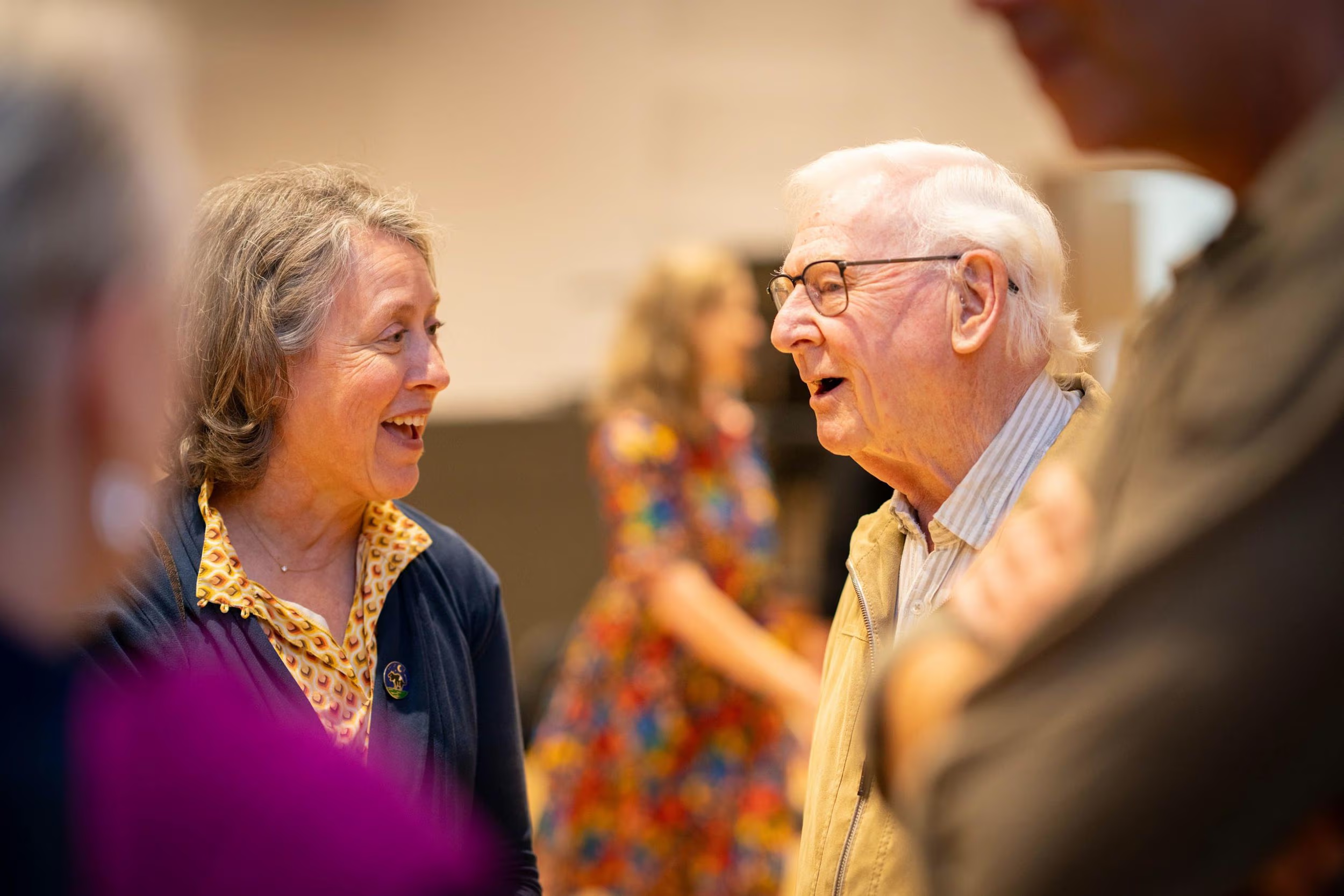
Pictured here with fellow TSO Publishing-represented composer Maria Grenfell, Don has had more than 50 compositions broadcast on ABC national radio and more than 60 works publicly performed in Australia, UK, US, Switzerland and Italy.
At 93, he is still a prolific composer of solo, chamber, choral, & orchestral music.
TSO Publishing Coordinator Thomas Misson recently sat down with Don at his Hobart home to learn more about what inspires his music.
His leafy home in the outer suburbs of Hobart is a creative shelter where the fire of his musical imagination burns perhaps brighter than ever.
Thanks for having me Don. Please tell me what inspired you to compose when you were younger.
My anglophile streak that led me towards English pastoralism and the music of Vaughan Williams.
However, this was challenged when I went to London to study with Malcolm Williamson, who was, at the time, the most commissioned composer in the UK, even though he was Australian.
Malcolm looked at my pastoral pieces and encouraged me to experiment with serialism to try and get 'unstuck'.
Pieces from this time included my String Quartet and Sextet.
How has Tasmanian shaped how you compose?
Malcolm Williamson’s tuition and living in England had me questioning this anglophile streak I had.
I loved Hobart immediately when I moved in the '60s and settled down with my young family.
The colour, and clarity compared to London’s grey and misty summers was a relief.
This was a revelation for me.
I felt liberated during the '70s as my ear was more flexible and technique was broader thanks to serialism helping me accept and use dissonance.
Having fallen in love with Tasmania and Hobart, I felt ready to try and make a 'Tasmanian music' style.
My goal was to pursue some place-based stylistic originality like Smetana, Vaughan Williams, and Sibelius but for Tasmania.
A lot of my best pieces in the '70s were full of exhilaration and joy.
My first piece responding to the Tasmanian landscape was Hastings for flute and piano, which later became part of the Hastings Triptych.
At Hastings there was very light and softly-sounding rain which I responded to by giving the piano 6 notes and the flute the other 6 notes of the chromatic scale, perhaps a reference to my studies in 12-tone technique.
In this vein, I also wrote the Edge of Remoteness which represented a 'growing up' as a composer.
The joy of the green and blue colours of the Tasmanian landscape was captured in my flute quintet, which is often in the pentatonic mode.
Please tell me about your history with the TSO.
When I first moved to Hobart, the TSO was a smaller and less polished orchestra.
Felix Gethen was the manager at the time, and he was very generous to me. Anything I wrote for orchestra he had played, and 15 works received performances during this time.
Richard Mills made a very good recording of the TSO performing The Legend of Moinee in 1993 for the Album There is an Island, which still gets broadcast very often today on ABC Classic.
More recently, the TSO has played the second movement of this work, while former TSO cellist Christian Wojtowicz has performed my Cello Sonata several times.
The Legend of Moinee received a standing ovation when played by the TSO in the Odeon Theatre in 1988. It was an overwhelming audience response to the piece and, being inexperienced at the time, and I didn’t know what to do.
They wouldn’t let me get off the stage and I felt a bit silly!
The TSO also played a reduced version of Dance Movement in my 90th year, a while back.
Thanks Don. When’s your next performance?
I’m looking forward to a concert of my music at the end of the year including Symphony No. 2 and other pieces of mine. This will be hosted by Holly Caldwell, who has done a lot of academic research on my music.
Explore Tasmanian music.
Explore our catalogue of works by Tasmanian and Australian composers at TSO Publishing.
.avif)
%20A7_0380%20DX.avif)