Concert Program

Elgar’s Cello Concerto

Saturday 22 Nov 2025 7:30pm
Federation Concert Hall, Nipaluna / Hobart

Müller-Schott’s cello sings of
struggle, hope, and quiet
triumph.
Image

The Tasmanian Symphony Orchestra acknowledges the traditional owners and continuing custodians of Lutruwita / Tasmania. We pay respect to the Aboriginal community today, and to its Elders past and present. We recognise a history of truth, which acknowledges the impacts of colonisation upon Aboriginal and Torres Strait Islander people and stand for a future that profoundly respects their stories, culture, language and history.

About the concert

Works

Grieg In Autumn, Op 11 (11 mins)

Elgar Cello Concerto in E minor, Op 85 (30 mins)

4 movements

  1. Adagio – Moderato
  2. Lento – Allegro molto
  3. Adagio
  4. Allegro – Moderato – Allegro, ma non troppo

20 minute interval

Brahms Symphony No 2 in D, Op 73 (43 mins)

4 movements

  1. Allegro ma non troppo
  2. Adagio ma non troppo
  3. Allegretto grazioso (quasi andantino)
  4. Allegro con spirito

💡 Stabat Mater

Find the Latin text and translation here.

This image is a black and white portrait of Eivind Aadland, TSO Chief Conductor and Artistic Director, in a white t-shirt, sitting at a dark table with a conductor’s baton in front of him. Eivind rests his chin on one hand and looks directly into the camera, with dramatic lighting creating contrast across his face and shirt.

Eivind Aadland. TSO Chief Conductor and Artistic Director.

Concert 101: Learn about the works being performed

For the enjoyment of all in the concert hall, please only watch Concert 101 before or after the performance. 

Uncover the stories behind the works.

Rustic. Playful. Magical.

In Autumn, Op 11

Composed by Edvard Grieg (1843–1907)

11 minutes

Edvard Grieg’s In Autumn, Op. 11, is a vivid and spirited concert overture that captures the changing moods of the season. Written in 1865 when Grieg was in his early twenties, it shows the young Norwegian composer beginning to find his distinctive voice – one that would later make him a national musical hero.

Originally conceived as a piano piece, In Autumn was later reworked for full orchestra, giving Grieg a chance to explore his gift for colourful orchestration. The music opens with the bright call of horns and woodwinds, evoking crisp autumn air and perhaps the bustle of a harvest festival. Soon, a more lyrical theme appears, suggesting the beauty and melancholy of fading light and falling leaves. Grieg contrasts these moods with lively dance rhythms and bold brass writing, painting a scene that feels both celebratory and reflective.

Listeners can already hear the qualities that would define Grieg’s later works – the influence of Norwegian folk music, the love of nature, and the ability to turn simple melodic ideas into music of emotional warmth and colour. The overture’s closing pages are exuberant and full of life, as though autumn is giving one last burst of energy before winter sets in.

While In Autumn is an early work, it is full of the freshness and imagination that would make Grieg one of the most beloved Romantic composers. It stands as a joyful celebration of nature’s cycles and a glimpse of the poetic, melodic voice that would later bloom fully in his Peer Gynt suites and Piano Concerto.

Melancholic. Tender. Timeless.

Cello Concerto in E minor, Op 85

  1. Adagio – Moderato
  2. Lento – Allegro molto
  3. Adagio
  4. Allegro – Moderato – Allegro, ma non troppo

Composed by Edward Elgar (1857–1934)

30 minutes

💡 FIRST-TIMER TIP

The names of movements in symphonies often follow traditional conventions that give insight into the character, tempo, and sometimes the form of each section.

These terms not only instruct performers on the tempo and mood of each movement but also guide listeners through the emotional and narrative arc of the symphony. For example, ‘Allegro’ refers to tempo and ‘molto’ translates to very, so: very fast!

Edward Elgar’s Cello Concerto in E minor, written in 1919, is one of the most deeply personal and moving works in the cello repertoire. It was Elgar’s last major composition and reflects both his own sense of weariness and the mood of a world emerging from the devastation of the First World War.

Unlike the grand, sweeping Romantic concertos of the 19th century, Elgar’s concerto speaks with intimacy and restraint. The music begins quietly, with a bold but melancholy statement from the solo cello – a cry of emotion that sets the tone for the entire work. The first movement unfolds with dignity and reflection, while the second bursts to life with quick, restless energy. The third movement is the heart of the concerto: lyrical, tender, and deeply expressive, it feels like a private confession. The finale revisits earlier themes, moving between passion and nostalgia before fading into a quiet, haunting close.

The concerto did not receive much recognition when it was first performed, but it was rediscovered decades later, largely thanks to the legendary cellist Jacqueline du Pré, whose passionate 1965 recording brought it worldwide fame.

Today, the Cello Concerto is seen as Elgar’s farewell – not only to the Romantic era, but to a world that had been forever changed by war. Its beauty lies in its honesty: music of sorrow, memory, and quiet courage. The soloist doesn’t so much compete with the orchestra as converse with it, creating one of the most touching dialogues in all of classical music.

Warm. Lyrical. Uplifting.

Symphony No 2 in D, Op 73

  1. Allegro ma non troppo
  2. Adagio ma non troppo
  3. Allegretto grazioso (quasi andantino)
  4. Allegro con spirito

Composed by Johannes Brahms (1833–1897)

43 minutes

Johannes Brahms composed his Symphony No 2 in D during the summer of 1877, in the peaceful surroundings of Pörtschach, a lakeside village in southern Austria. The setting seems to have inspired the music’s warm, lyrical character – so much so that the work is often nicknamed Brahms’ ‘Pastoral’ Symphony, though its moods are more complex than simple happiness.

After the long and difficult process of writing his First Symphony, which had taken nearly 15 years, Brahms completed his Second in just a few months. The result feels relaxed and spontaneous.

The opening movement unfolds gently, with a calm, flowing melody that seems to breathe the fresh air of the Austrian countryside. Yet beneath the surface warmth, there are moments of melancholy and introspection – reminders that Brahms never allowed sentimentality to go unchecked. The second movement is darker and more reflective, while the third offers a graceful contrast – part waltz, part rustic dance. The finale begins softly but quickly builds to one of the most exuberant conclusions in all of Brahms’ music, full of energy and radiant optimism.

At its premiere in Vienna later that year, audiences were struck by the work’s beauty and humanity. Critics described it as “sunshine” after the stormy drama of the First Symphony.

Brahms’ Second Symphony remains a favourite among orchestras and listeners alike. It combines warmth and intellect, lyricism and strength – music that feels both deeply personal and universally uplifting. It captures Brahms at his most approachable: thoughtful but not brooding, radiant yet grounded, and ultimately confident in the expressive power of the symphony.

Enjoying the concert?

Rewatch all your favourite moments on TSO On Demand.

Streaming sixteen concerts from Federation Concert Hall, this is the full orchestra at its brilliant best.

Tasmanian Symphony Orchestra on stageTasmanian Symphony Orchestra on stage

Start Watching

Musicians

Eivind Aadland

TSO Chief Conductor & Artistic Director

Supported by Anonymous

Eivind Aadland.

Eivind Aadland is one of Norway’s most respected conductors. Since 2020 he has been Chief Conductor and Artistic Director of the Tasmanian Symphony Orchestra. He was Chief Conductor and Artistic Leader of the Trondheim Symphony Orchestra for seven seasons from 2004, during which time he conducted the complete Beethoven and Mahler symphony cycles. His extensive work with Scandinavian orchestras includes regular guest engagements with the Oslo and Bergen Philharmonics, the Stavanger Symphony, the Gothenburg Symphony and the Swedish Chamber Orchestra. In addition, he has conducted acclaimed productions of Don Giovanni, Le nozze di Figaro, Die Zauberflöte and Die Fledermaus for Den Norske Opera, Oslo.

He has also worked extensively in Asia and Australia. He is a frequent visitor to the WDR Symphony Orchestra Cologne, the National Orchestra of Belgium and Iceland Symphony Orchestra. He has also worked with Orchestre national du Capitole de Toulouse, Gürzenich-Orchester Cologne, Strasbourg Philharmonic, Lausanne and Scottish Chamber Orchestras and the symphony orchestras of Melbourne, Finnish Radio, Bamberg, Staatskapelle Weimar, SWR Stuttgart and Tokyo Metropolitan Symphony Orchestra. In addition to his career as a conductor, Eivind Aadland is a devoted collector of, and authority on, contemporary art. His private collection encompasses works in the diverse media of painting, photography, video and installation.

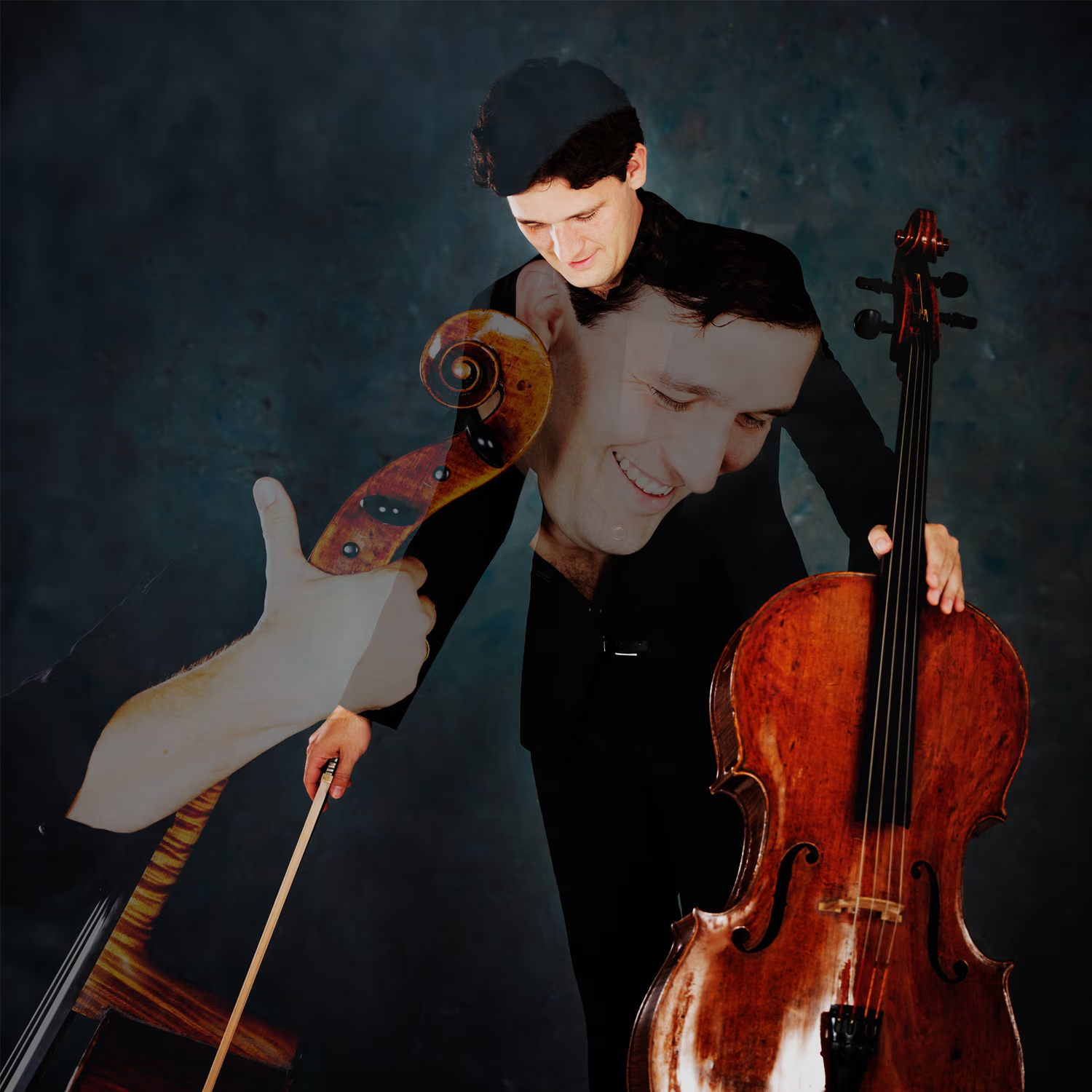
Daniel Müller-Schott

Cellist

Daniel Müller-Schott. Copyright Uwe Arens.

Image credit: Uwe Arens.

Müller-Schott is one of the most sought-after cellists in the world and can be heard on all the great international concert stages. For many years he has been enchanting audiences as an ambassador for classical music in the 21st century, as a bridge builder between music, literature and the visual arts. The New York Times refers to his "intensive expressiveness", describes him as a "fearless player with technique to burn".

Müller-Schott guests with international leading orchestras in the United States, Europe and Asia, has appeared in concert with such renowned conductors as Marc Albrecht, Karina Canellakis, Thomas Dausgaard, Christoph Eschenbach, Iván Fischer, Alan Gilbert, Manfred Honeck, Fabio Luisi, Cristian Măcelaru, Susanna Mälkki, Andris Nelsons, Gianandrea Noseda, Andrés Orozco-Estrada, Kirill Petrenko, Vasily Petrenko, Jukka-Pekka Saraste, Dalia Stasevska, Krzysztof Urbański, Jaap van Zweden und Simone Young.

Daniel Müller-Schott studied under Walter Nothas, Heinrich Schiff and Steven Isserlis and was supported personally by Anne-Sophie Mutter. At the age of fifteen, he won the first prize at the International Tchaikovsky Competition for Young Musicians in 1992 in Moscow. Daniel Müller-Schott plays the “Ex Shapiro” Matteo Goffriller cello, made in Venice 1727.

Tonight’s orchestra

Eivind Aadland Conductor

James Ehnes Violin

Tasmanian Symphony Orchestra

Violin

Emma McGrath Concertmaster 

Ji Won Kim Associate Concertmaster 

Tobias Chisnall Principal Second

Rohana O'Malley Principal First

Kirsty Bremner

Miranda Carson

Yue-Hong Cha

Margaret Connolly

Frances Davies

Christine Lawson

Elinor Lea

Xinyu Mannix

Christopher Nicholas

Hayato Simpson

💡 FIRST-TIMER TIP

Did you know our Concertmaster plays a violin hand-crafted by one of the finest and most important luthiers (a string-instrument maker) of the nineteenth century, Jean-Baptiste Vuillaume (1798–1875).

He crafted 3000+ instruments in his time and we’re very proud to have a violin made in 1845 on loan from two of our generous Tasmanian patrons.

Viola

Caleb Wright Principal

Douglas Coghill

Anna Larsen Roach

William Newbery

Karina Schmitz

Cello

Jonathan Békés Principal

Ivan James

Nicholas McManus

Martin Penicka

Double Bass

Stuart Thomson Principal

Matthew McGrath

Harry Young

Flute

Lily Bryant  Guest Principal

Lloyd Hudson  Principal Piccolo

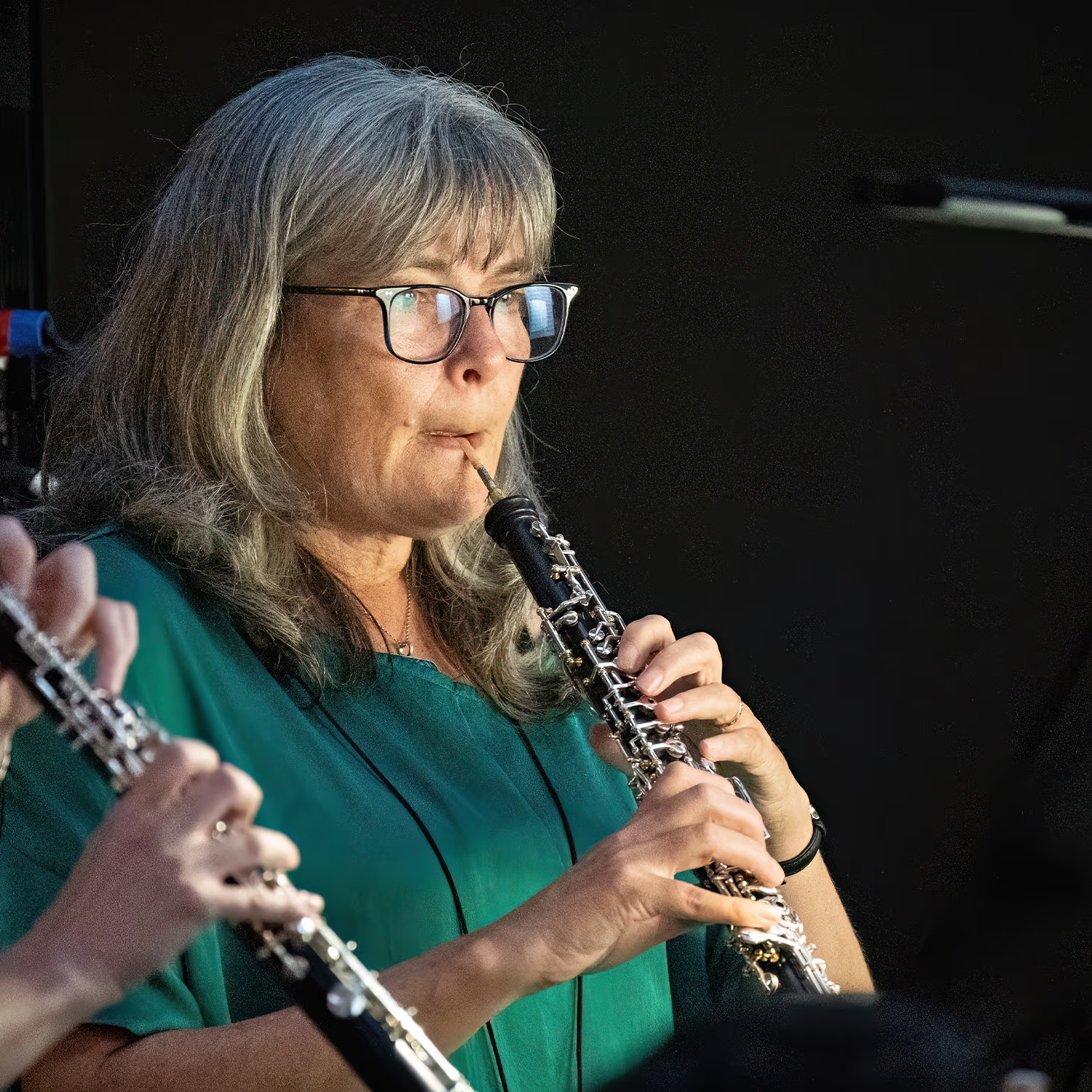
Oboe

Rachel Bullen Guest Principal

Dinah Woods Principal Cor Anglais

Clarinet

Andrew Seymour Principal

Eloise Fisher Principal Bass Clarinet

Bassoon

Tahnee van Herk Principal

Melissa Woodroffe Principal Contrabassoon

Horn

Claudia Leggett Principal First

Hannes Kaukoranta

Trumpet

Fletcher Cox Principal

Mark Bain

Trombone

David Robins Principal

Jackson Bankovic

Jack Machin

Bass Trombone

James Littlewood Principal

Tuba

Rachel Kelly Principal

Timpani

Matthew Goddard Principal

Percussion

Gary Wain Principal

Tracey Patten

Harp

Meriel Owen Guest Principal

Piano

Karen Smithies Guest Principal

Celeste

Jennifer Marten-Smith Guest Principal

Saxophone

Jabra Latham Guest Principal

Benjamin Price Guest Principal

Organ

Nathan Cox Guest Principal

*Correct at time of publishing

Return to Navigation →

Federation Concert Hall

Our Southern Home

Federation Concert Hall has been our home since 2001. It's distinctive curve, golden Tasmanian timber, contemporary design and deep red seats set the tone for the ultimate concert experience. 
 
In 2020, major acoustical enhancements were made to the hall, amplifying the venue's, and the TSO's, reputation as world-class. 

Photo credit: Fin Matson

💡 FIRST-TIMER TIP

A 'movement' is a longer piece of music broken up into bite-size pieces. It makes it easier to perform and provides contrast within the work. Find out more here.

Orchestra performing in Federation Concert Hall.

Getting THere & Accessibility

Everything you need to know about Federation Concert Hall.

Find Out More
Hadley's Orient Hotel

Make it an experience

Hotel Offers from Hadley's Orient Hotel

Nestled among other architectural masterpieces in Hobart's city centre, this heritage-listed hotel plays host to almost two centuries of stories, scandals and secrets. The floor boards whisper of the hotel’s rich and often tumultuous history.

Federation Concert Hall

💡 FIRST-TIMER TIP

What are acoustics and how do they affect my concert experience?

Acoustics are the science of sound, or the way a venue can deliver the thunderous feeling of strings and brass, or the ring of the triangle over all the other instruments.

Read more about the acoustics of the Hall here.

Karen Gomyo

Coming up

Karen Gomyo

Sparks will fly, featuring Karen Gomyo.

Delius The Walk to the Paradise Garden
Dvořák Violin Concerto in A minor, Op 53
Robert Schumann Symphony No 1 in B-flat, Op 38, ‘Spring’

Christmas with the TSO. A festive knitted pattern with a bright red background featuring rows of Christmas-themed designs. The top and bottom rows have white decorative stitches. The middle section displays the large white letters “TSO” surrounded by brown violins on each side. Above and below this, there are alternating green Christmas trees and tan reindeer heads with white antlers.

Coming up

Christmas with the TSO

Featuring baritone Samuel Dundas and the TSO Chorus, with Guy Noble as conductor and host.

Program includes Jingle Bells, Hallelujah Chorus, The Nutcracker, Silent Night and more.

Find Out More

Our supporters

Whether sponsoring a musician in the orchestra, or supporting our invaluable community programs, so much of what we do relies on you. We offer our deepest thanks to all our Partners, Patrons and Friends.

Support the TSO and connect with our orchestra beyond the concert hall.

Donate Now
5G Networks

Huon Pine Patrons

John Cauchi AM & Catherine Walker Chair Patrons

Anne & Don Challen AM Chair Patrons

Jane Drexler

Rob & Tricia Greenwell Chair Patrons

David & Catherine Hamilton Chair Patrons

Marie Heitz Chair Patron

In Memory of Ian Hicks Chair Patron

Belinda Kendall-White Chair Patron

Patricia Leary Chair Patron

Penny Le Couteur & Greg Dickson

Ang Madden Chair Patron

Emma & Dom McNamara

Mountain Air Foundation Chair Patron

R H O'Connor

Andrew Parker & Caroline Sharpen Chair Patrons

Chris & John Sandow Chair Patrons

Dr Peter Stanton Chair Patron

TasPlates

Dr Hilary Wallace Chair Patron

Deirdre & Trevor Wise

Anonymous (2)


TSO Concertmaster Emma McGrath plays an 1845 Jean-Baptiste Vuillaume violin on loan from two of our generous Tasmanian patrons.

Sassafras Patrons

Cath Adams & Steve Craft Chair Patrons

Damian Bugg AM & Jenny Bugg

John & Marilyn Canterford

Dr Joanna de Burgh

Marc & Susan Duldig Chair Patrons

Richard & Harriett England

Emeritus Prof Andrew Glenn & Dr Odile Glenn Chair Patrons

Elizabeth Haworth & John Diment Chair Patrons

Suzanne Kirkham

John Langford

Diane Matthews

Anthony G McGee AM Chair Patron

Louise & Tim Mooney AM Chair Patrons

Bill Oakley OAM Chair Patron

Jan & Alan Rees Chair Patrons

Dr David & Mrs Glenys Rich Chair Patrons

Dr John & Mrs Barbara Roberts

James and Jacqueline Roberts-Thomson Chair Patrons

Rotary Satellite Club of Sandy Bay, Battery Point

Dr Di Stow Chair Patron

Michelle Warren

Anonymous (3)

Leatherwood Patrons

Andrew Bennett

Suzanne & Martin Betts

Peter Brooks

Elizabeth Bugg

Janet Carding

Helen Carrig

George & Jan Casimaty

Dr Josh & Wendy Cocker

Prof Mike Coffin

Beth Coombe

Stephanie Cooper

Simon Coultas

Vicki Cowles & Josef Neuschwanger

Nick & Janet Cretan

Emeritus Prof Stephen Crump

David Davey & Annick Ansselin

Allanah Dopson

Roger Fisher

TJ Foster

Giameos Constructions & Developments

Mr Tony Hagar

Amelia Hagger

Ms Keri Handley & Mr Frank Martin

Susan Hawick AM

Dr Donald Hempton

Peter & Jeanne Hepburn

Janet Holmes à Court AC

Dr David & Donna Humphries

Don & Christine Jeffrey

Prof Matthew Jose

Paavo Jumppanen

Veronica Keach

Judith Ker

Yury Kudryavtsev

Betty Kuhl

Harvey Lennon

David Lloyd

Marilla Lowe

Linda & Martin Luther

Dr Katherine Marsden

Maggie McKerracher

Margret Monks

Sarah Morrisby

Professor Robert Morris-Nunn

Alison Nadebaum

Jan Nicholas

Sindi O'Hara & Peter Pickett

Alison E Parsons

Catherine Prideaux

Helen Ross & Margaret Whiteside

Margaret Sallis

Deirdre Schoe

Dr Johannes Schonborn

Jenny Scott

Dick & Sue Shoobridge

Christopher Spiegel

Tony Stacey AM & Mrs Jeanette Stacey

Mr Ken Stanton

Janet Tomlinson

Rowland Turner

Frances Underwood

John Usher OAM

Hank & Elizabeth van Herk

Kim Waldock

Jacqui Walkden

Dr Michael Wilkinson

Geoff & Vicki Willis

Lindsay & Rae Young

Jane Zimmerman

Anonymous (7)

Blackwood Patrons

Simon Allston & Janeil Hall

Jacqui Blowfield

Kim Boyer

Dr Nicholas Brodie

Robert and Lisa Brodribb

Deborah Brook

Cameron Bryer

Jenny & Ian Burleigh

Victoria Burley

Roger Carrington

Dr Helen Chick

Heather & Christopher Chong

Gail Cork

Janet Crane

Amy Crosby

Jane Edmanson OAM

Ms Gail Friesen

Dr Brita Hansen & Frank Halley

Susie Harrison

Shirley Honeysett

Peter Hordern

Ross Kelly

Mary Ellen i m Kerensa

Richard & Julia Metcalf

Gisele O'Byrne AM

Tony Purdon

School for Seniors Rosny

John Sexton

Dr Tanya Stephens

Priscilla Travers

Jeanette Tremayne

Residents of Vaucluse Gardens

Judith Waldock

Jane Wilcox

Polly Woods

Dr Rosemary Yeoland

Anonymous (9)

Silver Wattle Patrons

Trevor & Barbara Abbott

Michael Alchin

Chris Andrews & Jill-Maree Geeves

May Backhouse

Dennis Bewsher

Dixie Brodribb

Elizabeth Chelkowska

Christine Coombe

G. D. Couninis

Tony & Kate Dell

Heather Ebbott

Sam Finlay

Sari Goddam

John Heathcote & Mary Feeley

Sharron Hewer

Ann Hopkins

Linda Jackson

Peter Jarvis & Ans van Heijster

Louise Klein

Sue Kremer

Ted Lefroy

Chris & Dot Lloyd-Bostock

William Lo

Rose & Thomas Marwick

Sandra Michael

Jane Monaghan

Dr Robyn Munro

Meriel Owen

Leone Paget

Shefali Pryor

Springhaven Lifestyle Village

Grant & Elizabeth Taylor

Diane & Neville Truskett

Judith and Rod Tudball

Julian Type

Dr Johanna Wadsley

Dr Roland Warner

Christopher Waterhouse

Anonymous (12)

Government Support
Australian Government
Creative Australia
Tasmanian Government
Premier Partners
AWM Electrical - Metal Manufactures Pty Limited
D&W - Metal Manufactures Pty Limited
City of Devonport
TasPlates.com
Wine Partner
Bangor Vineyard
Partners
AWM Electrical - Metal Manufactures Pty Limited

Questions & Tech Support

Chat with one of our friendly staff at the TSO Box Office.

We value your feedback

Let us know your thoughts and ideas on the new digital programs here.