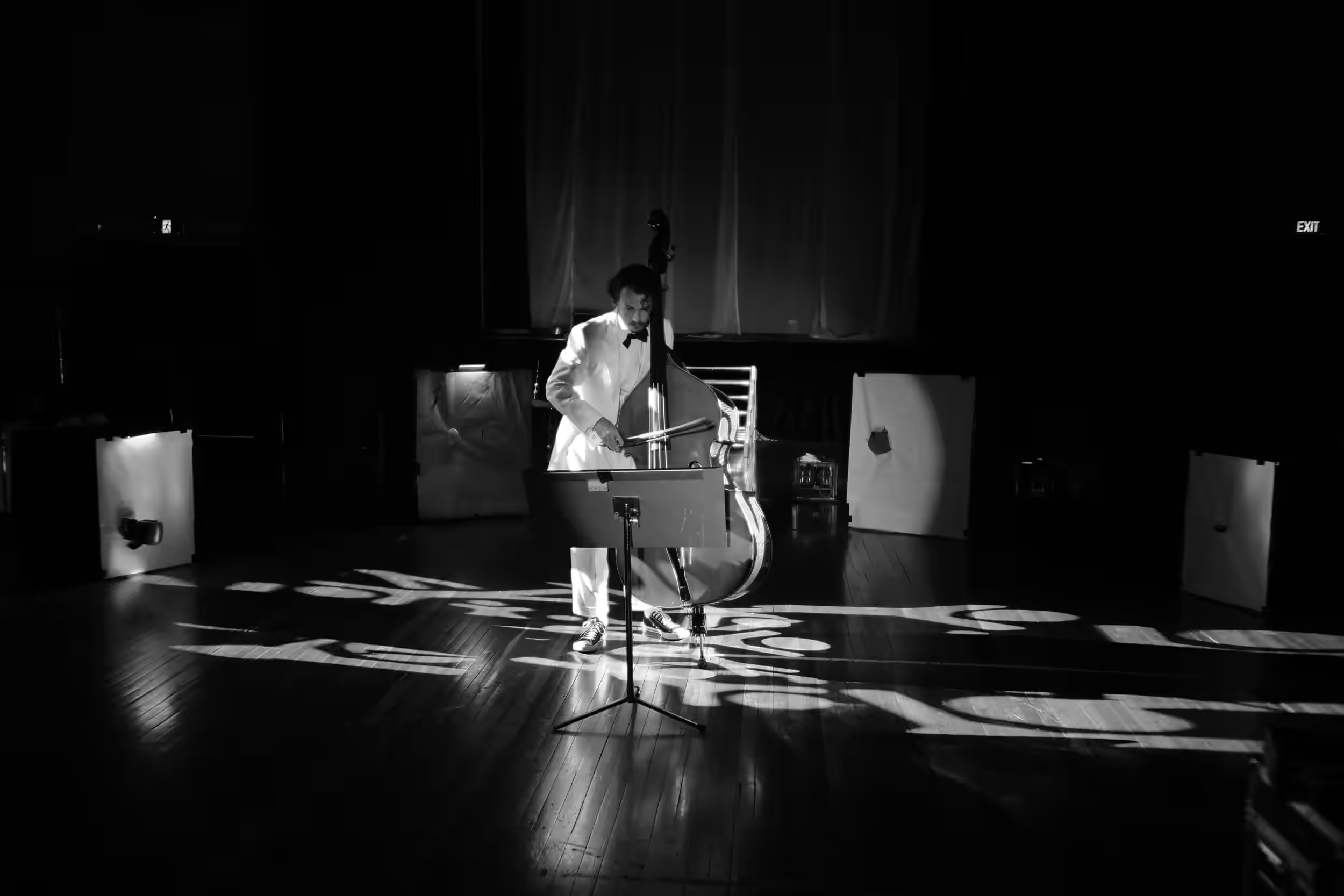
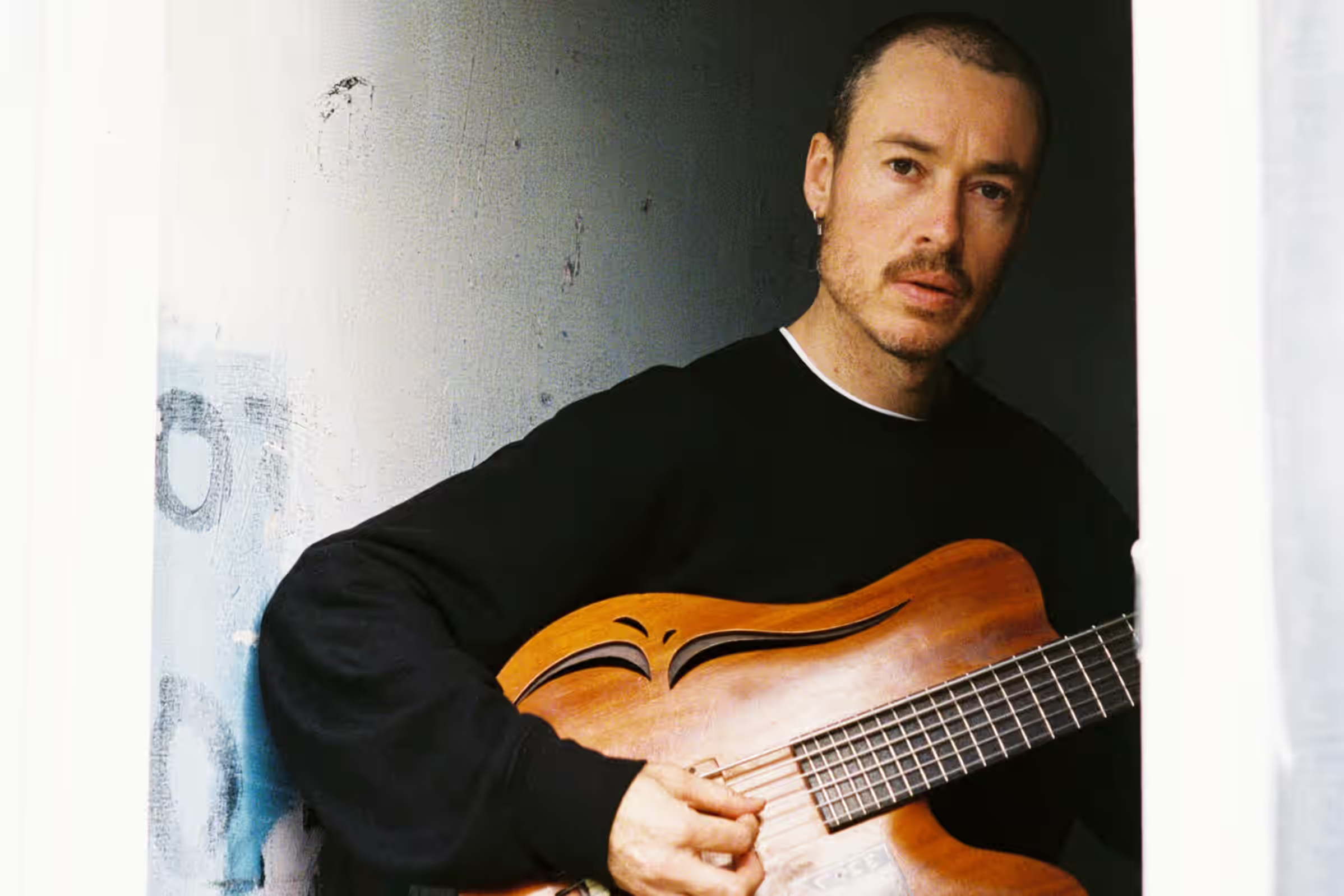
Joseph Franklin is a composer and bassist working across contemporary classical, improvisation, experimental, and sound art.
Based in Philadelphia in the US, the Australian-born artist has won numerous awards, residencies and fellowships.
He has released several albums as bandleader, with performances in the United States, Germany, Switzerland, Senegal, Belgium, France, Turkey, and Australia.
Some of his exciting works are available at TSO Publishing.
TSO Publishing Coordinator Tom Misson recently caught up with Joseph from Italy where he was introducing some Aussie vernacular to a festival of Italian opera!
Hi Joseph, your work is often described as ‘experimental’. What does the word mean to you, if anything?
It seems to be a catch-all for things that are hard to articulate, yet it still points to some sort of process.
In my process, I don't always know how the overall form of a piece will turn out, and how certain components will function.
There is a lot of research and pre-composition (calculated guessing?) and always elements of risk, which, when it pays off, can be highly satisfying.
This is informed by my practice as an improvising bassist, in which there is an interplay between the player, the instrument and the space.
Of the four definitions given by Apple's dictionary, it’s the final (archaic) definition that I find most appealing – ‘knowledge based on experience as opposed to authority or conjecture’.
That term ‘opposed to authority’, which includes the bending of strict disciplinary boundaries, resonates strongly and motivates much of my compositional practice.
No matter how much you understand what’s happening technically in a musical work, there’s always some sort of sorcery at play when a piece moves a listener.
Can you describe some recent responses to your music by performers?
In Lucca, Italy, where I’ve been steeped in a festival of Italian Opera, a great young baritone premiered my setting of Australian poet John Kinsella's DEATH OF A ROO DOG.
The singer found the piece somewhat experimental, because it asked more of his voice than traditional operatic techniques.
It seems that in some contexts, such as the operatic environment in Italy, the treatment of the voice – asking the singer to pronounce key words in an Australian accent, with exaggerated inhales and exhales, and alternate melodic options – is considered experimental.
But if you listen to songwriter Gareth Liddiard, it's not his Australian accent that is experimental. Context determines a lot.
By contrast, the New York ensemble Ekmeles recently premiered a vocal sextet of mine that was set to a poem by Kaurna-based poet Tadgh Porter-Cameron.
The piece utilises quarter and microtones, rapid passages, extreme vocal ranges, Australian pronunciation, and an overtly political text about nationalism in Australia.
For Ekmeles, it was just another day at the office, as they routinely premiere far more demanding work.
What drew you to less ‘traditional’ ideas in music and did a more experimental approach solve a compositional problem for you?
More than genre or style, I'm interested in cartography: mapping a series of conceptual, familial, historical, environmental-elemental and artistic relations.
I want to understand place through situated storytelling, and to ask which philosophical, musical, and political ideas are alive for me and my peers right now.
I draw from traditional and experimental music around the world – not to replicate it, but to ask questions that are not necessarily centred on Western conceptions of composition or improvisation, so that any departure carries weight and responsibility.
How do you know when a piece is finished?
Was it Da Vinci or Paul Valéry who said that ‘a work of art is never finished, only abandoned’? Whoever it was, this rings truer with each new piece.
The amateur permaculturist in me thinks of my scores as compost-like: nothing is ever new, original or finished – rather, it's a complex and essential living process. Each piece is up for re-composition (re-composting) as needed.
Each time a piece goes through the iterative process, it is improved upon, enriched, becoming more nuanced and fertile for new growth.
Rather than a constant search for ‘new music,’ this is more of a cyclical process where it becomes less about the composer-as-pioneer, and is a dialogue with the transforming musical materials that seem to take on their own agency.
Where Things Were Once Conjoined for double bass and orchestra, which the TSO premiered with soloist Matthew McGrath in October 2025, went through several iterations.
A piece is abandoned when it has told me everything it can, and when I can no longer hear what it still needs.
.avif)
%20A7_0380%20DX.avif)